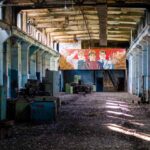

There were rumours that the best Italian alcohol was produced here.
Video
The former distillery complex known as ex Alc.Este or ex Distilleria Eridania sits on the western outskirts of Ferrara, in the Emilia-Romagna region, wedged between the Boicelli and Burana canals within a large rectangular fenced lot covering approximately 20 hectares. What remains is an enormous industrial landscape: mega silos open to the sky, a distillation tower that still dominates the skyline of the western city, chemistry laboratories on the third floor of one building with test tubes and flasks still on the shelves, workers’ housing, an internal customs office, flooded basins of rainwater that accumulate in open silos, and bivouacs of homeless people in every sheltered corner. Vegetation has entered every crack. The plant closed definitively on 5 March 2007, and in 2017, demolition of some buildings began after all the machinery had been resold or scrapped. What stands now is partly what remained after the demolition crews left, and partly what they could not yet reach.

Historical Context
1938: Military Additives That Were Never Made
The distillery was born in 1938 as the Fabbrica Italiana Derivati Acetilene (FIDA), with the original objective of producing fuel additives for civil and military use. The wartime industrial programme that created it was never fully realised — the additives were never manufactured at scale — and the plant found its true function only in the post-war period. After the Second World War, it was reconverted by Distillerie Italiane S.p.A. into a complex for producing ethyl alcohol from sugar beet molasses. The Po Valley’s sugar beet industry, centred on the great zuccherifici of Ferrara and the surrounding plain, provided the raw material; the distillery processed the molasses — a by-product of sugar refining — into alcohol for food, industrial and cosmetic uses. Subsequently, the plants were acquired by the Eridania group, making them one of the most important Italian factories for producing alcohol used in food and cosmetics. Under the Alcol Buongusto brand — one of the most recognisable names in Italian domestic alcohol — and as a producer of alcoholic bases for industry and cosmetics, the complex became, for several decades, one of the largest alcohol producers in Europe. The Eridania group’s corporate colour was blue, which in the 1980s still characterised the site’s signage and branding.


The EU Directive and the End of Production
Towards the end of the twentieth century, a crisis and consequent closure of many Italian sugar factories began, partly due to EU policy. This imposed a reconversion of the distillery towards bioethanol production to avoid the closure of a plant of significant size and a generator of local economic activity. The distillery invested heavily in the conversion, producing bioethanol through the 1990s and into the early 2000s. The EU directive simply required member states to proceed with a gradual increase of the “bioethanol” share in fossil fuels, reaching the ideal ceiling of 5% (with a minimum of 2.5%) by 2010. Italy took three years to transpose the directive into law and implement it, without providing tax relief or incentives to the producing companies. Operating in a market dominated by extra-EU producers, without fiscal support, the bioethanol conversion became commercially unviable. The plant closed for good on 5 March 2007. Deterioration of the buildings began in 2007 with the crisis of the sugar sector; by 2017, demolition of several structures had begun after all machinery was resold or scrapped.


Architecture and Space
The Tower and the Canals
The defining architectural element is the distillation tower — tall enough to loom over the surrounding western district of Ferrara even now, visible from the canal bridges and from the road. Despite its ground floor being covered in debris and excrement, the tower’s structure remains the most solid element of the complex, and from its roof, on clear days, the view over Ferrara is worth the climb. The rest of the complex consists of a variety of building types: large silos — some roofed, others stripped open by wind and time — workers’ housing, an internal customs office (the distillery produced alcohol that required excise supervision), and a dedicated building housing the chemistry laboratories on its third floor, surrounded by other structures towards the centre of the complex.

What We Found
The Laboratories
Laboratories further towards the centre of the complex, full of test tubes, flasks, books on chemistry, small contraptions and syringes, constitute the heritage of this unused area. Any of us can smell the air saturated with the history of this distillery and imagine what came before the abandonment — people working, making experiments, talking. It is a little bit disquieting as a moment.


Artificial Swimming Pools
Almost everywhere you can find “artificial swimming pools” — rather, silos and structures filled with water inside, filled by rain.
A Free Gym for Parkour
We also have a surprise for people passionate about parkour and free running. Be prepared with this super open gym just for you.

The Bivouacs
Now home for homeless people, it is not rare to bump into bivouacs dispersed through the complex. Food, a lot of drinks, porn journals and even warnings not to enter their “house” are almost everywhere. Not only is the ground livable, but life is also hidden in the underground, where humidity, water and bad smells are the protagonists.
The Tower Roof
The distillery, both in size and location, as well as for its famous tower, looms gloomily over the city. The latter, despite being empty and the ground floor full of dirt, has a different structure — still solid — and on beautiful days, the view you can enjoy from the top is worth the trip.


Current Status
The area of the ex distillery is owned by Real Estate Ferrara, part of the Gruppo Maccaferri of Bologna, and is earmarked for urban regeneration, with the recovery of the historic industrial buildings, public infrastructure works (backed by a guarantee of €4,800,000, including a roundabout between via Eridano and via Modena), the recovery of the Boicelli and Burana canal banks, and the free public transfer of a 78,000 square metre ecological area. A masterplan by WNA – Walter Nicolino Architects with LBLA + Partners envisages a new neighbourhood on the 20-hectare site, structured around a green ring and a park road distributing pedestrian and cycle flows, with the historic industrial buildings recovered for new uses. In 2023, an alternative proposal for a green hydrogen plant (estimated investment of €50 million) was put forward, but faced planning obstacles because the residential conversion plan would first need to be formally reversed in the municipal council. A joint operation by the State Police and Local Police to clear and clean the area was carried out in 2019 and repeated in 2023. As of July 2024, reporting by La Nuova Ferrara described the site as still deeply derelict, with makeshift shelters, stagnant liquid basins producing gas bubbles, and vegetation advancing through the structures. As of the time of writing, 2026, no construction has begun. The site remains standing, increasingly overgrown, a large and unresolved piece of Ferrara’s western urban fabric.


Urbex location: