
Would you like to feel what the first ball was for Natasha Rostova from “War and Peace” by Leo Tolstoy? Or to see what kind of dance was popular in the time of Scarlett O’Hara in “Gone with the Wind” by Margaret Mitchell? A little piece of that dancing epoch you can find inside the Grünau Ballhaus in Berlin.
This dance floor is becoming a luxury retirement home. On the eastern bank of the Dahme River, in the Berlin district of Grünau, two adjoining buildings at Regattastraße 161 and 167 once formed the social heart of a neighbourhood built around water sport and weekend leisure. To reach them from Grünau S-Bahn station, visitors follow Wassersportallee toward the river and turn onto Regattastraße, where the buildings sit set back from the road behind a perimeter fence with several gaps. There is no way in through the main entrance; access has traditionally come from the rear, near the water, through broken window openings shared by both structures. For decades, the two halls stood as a matched pair of ruins, though as of the most recent reporting, that description no longer fully applies to either of them.

Historical Context
Grünau developed into a fashionable destination for Berliners in the late nineteenth century, driven largely by the opening of a rowing course on the Dahme in 1880 and the first official Grünau Regatta, held that June, which drew local rowing clubs together for the first time. The Gesellschaftshaus Grünau, at number 167, was commissioned by the Berlin stockbroker Schmidt and inaugurated in 1875, later expanded around 1897–98 with a grand ballroom nine meters high. Next door, what became the Ballhaus Riviera grew out of a modest tavern around 1888 before being rebuilt as a proper dance hall in 1890, complete with a palm-lined outdoor dance terrace, its own restaurant, and a private pier where boats occasionally carried dancers further down the river toward the beer gardens near the regatta course.

Under Kraft durch Freude and the HO
By the 1920s, both venues had become fixtures of Berlin’s cultural life, attractive enough that playing there was considered an honour among musicians of the period. During the Nazi era, the two halls were reportedly operated under the auspices of Kraft durch Freude, the state leisure organisation tasked with managing and monitoring the population’s free time. Remarkably, the buildings survived both world wars with relatively little damage. After 1945, Soviet military administration transferred oversight of Grünau’s sport and hospitality facilities to the Köpenick district authority, and through the GDR period, the two halls continued operating under the state trading organisation known as the HO, remaining popular enough that steamers of Berlin’s White Fleet regularly docked at the pier to bring visitors for dances and events. A discotheque opened inside in the 1980s, drawing large weekend crowds even as the building’s original grandeur had already begun to fade.

Closure After Reunification
German reunification in 1990 marked the beginning of the end. Management of the site passed to the Treuhandanstalt, the agency responsible for privatising former East German state assets, and both halls closed permanently in 1991. What followed was two decades of stalled negotiations: heritage protection, granted to the ensemble in 1977, required any future owner to preserve the Riviera’s Art Nouveau facade and the Gesellschaftshaus’s large ballroom even if the rest of the complex were demolished, and the cost of meeting that requirement was estimated at around 15 million euros — a figure high enough that prospective buyers repeatedly walked away. An investor from Ankara acquired the property in 2006 but made little visible progress for years, and a local citizens’ campaign gathered some 1,600 signatures in 2013 pressing the district to intervene and secure the crumbling structures.

Architecture and Space
Both buildings belong to Berlin’s turn-of-the-century tradition of riverside excursion architecture, built to accommodate the crowds drawn to Grünau’s regatta culture. The Ballhaus Riviera‘s street-facing facade is characteristic Jugendstil, or German Art Nouveau, with ornamental window framing that has remained legible even through decades of decay, while its interior once centred on a spacious dance hall opening onto the palm terrace and river view. The Gesellschaftshaus’s defining feature was its nine-meter ballroom, tall enough to feel closer to a civic hall than a restaurant annex, supplemented by a smaller, more intimate room decorated with arabesque stucco figures — a dandy with a wine bottle and a bare-shouldered woman in a corset — a fin-de-siècle flourish that hinted at a more private, decadent side of the venue’s social life. The complex also included bathing and sporting facilities attached to the Gesellschaftshaus, which at points rivalled the Riviera in popularity before falling further into disuse.

What We Found
I should say that the second building is useless to visit: there is nothing left inside. Though if you still have decided to go, be really careful, it’s really dangerous to be in, as the house could collapse at any minute. By the way, before it also had an impressive ballroom, bathhouse and sporting facilities. It was at one point as popular as Ballhaus Riviera, but not anymore.

The Ballroom That Lives Again
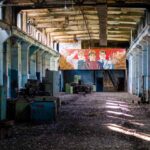
What is most interesting is the ball house itself. When you get in, the first thing you see is a huge ballroom… Close your eyes, wear your beautiful dress and turn on the music. Voilà! Everything lives again here, just dance, dance, and don’t stop!

The Piano Left Behind
In the ballroom, there is even a piano and a chair left, so if you don’t have enough imagination to see the music, just create it!
And then, when you are tired, go through the rooms that are left: there are still some elements of decor from that time. Enjoy!
Before coming here, I had looked through some photos of this place and found out that a lot of things are already in the past. This place is already a pile of ruins — what will happen to it in several years, or even months?
So I would totally suggest visiting this place now if you are staying in Berlin. Later will already be too late.

Current Status
That last observation, made before the site’s redevelopment, has largely come to pass, though not in the way most abandoned-building visits end. Following further ownership changes, the Berlin-based developer Terragon Projekt GmbH acquired both properties and received district approval in early 2019 for a first construction phase converting the ensemble into a senior residential complex, built around new buildings while preserving the Riviera’s ballroom for restoration as an event space and the Gesellschaftshaus’s protected facade and hall. The process was not smooth: a serious fire, in which arson was not ruled out and two young suspects were briefly detained, badly damaged the Gesellschaftshaus roof and forced the emergency demolition of unstable sections. Restoration work nonetheless proceeded between 2018 and 2021, and the finished complex, incorporating both historic structures alongside new residential buildings, opened as a senior living facility known as VILVIF. Within the restored Gesellschaftshaus ballroom, a restaurant called Riviera opened to the public in November 2022, though according to press reporting, it closed again roughly thirteen months later, in late 2023 or early 2024, amid ongoing construction disruption on Regattastraße. As of the most recent available reporting, in late 2025, the historic ballroom itself has reportedly been repurposed again as a dining venue offering formal evening service, while the Gesellschaftshaus grounds now function as part of the private senior residence. No current public access to the interiors described above should be assumed; the buildings, while still standing and largely restored, are no longer in the abandoned condition this account describes.

Urbex location: