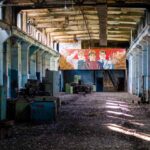

How do you find a situation where the city starts the project to tell about the most important event for it, in quite large-scale forms, and then suddenly it runs out of money? Awkward, isn’t it? Such a story happened with the Sevastopol Defence Museum, which they tried to build exactly in the city centre, but at one point something went wrong.
On Cape Khrustalny, near the giant monument to the Sailor and the Soldier that dominates almost every skyline view of Sevastopol, stood — until recently — the abandoned shell of a museum that was never allowed to open. The site is unmistakable: the monument itself, over 40 metres tall, can be seen from nearly any point in the city, and the ruined structure sat quietly beside it for decades, ignored by most of the people who photographed the statue in front of it. What follows is the story of a building the Soviet Union began with considerable ambition and then simply stopped building, for reasons that had nothing to do with the history it was meant to commemorate.

Historical Context
A Memorial Commissioned by Moscow
In May 1972, the Central Committee of the CPSU and the Council of Ministers of the USSR jointly adopted a resolution ordering the construction of a memorial complex to commemorate the defense of Sevastopol, the 250-day siege that ran from October 1941 to July 1942 before the city fell to German and Romanian forces. A design competition followed, drawing four author teams from Moscow, Leningrad, Kyiv, and Sevastopol itself; the Kyiv team’s proposal was selected as the winning design for the complex, which was to include a monument, an eternal flame, and a museum dedicated to the defence.
Seven Years of Construction, Then Nothing
Ground was broken in 1981, under the direction of architect Nikolai Zharikov, with construction proceeding with considerable state investment; by December of that same decade, the total projected cost of the complex stood at around 6 million Soviet rubles, for a museum building alone planned at roughly 6,000 square metres. Work continued through the 1980s — by 1989, the monument portion of the project was reported to be 72 per cent complete — but the funding collapsed with the broader economic crisis of perestroika, and in 1988 construction on the museum stopped entirely. It has never resumed.

Decline and Abandonment
What followed was not neglect so much as prolonged institutional indecision. In 1990, Sevastopol’s city council formally requested permission to demolish the unfinished monument altogether, dismissing it as an artistic failure, though the request went nowhere amid the broader collapse of the Soviet Union the following year. In 1992, Ukrainian authorities, having inherited an unfinished museum building they had no funds to complete, auctioned it off for a sum equivalent to roughly 100 rubles today — a gesture that solved nothing and left the structure in the same limbo. The adjoining monument itself was eventually rescued: renewed funding in the 2000s allowed it to be completed and formally opened on 9 May 2007, an anniversary chosen deliberately for Victory Day. The museum building beside it received no such reprieve. For years afterwards, it remained a magnet for local youth and photographers, its walls covered in what local accounts describe as some of the most interesting graffiti anywhere in the city — before, in 2015, twenty-seven years after construction had stopped, demolition of the unfinished complex finally began.

What We Found
Quite near — the monument to the Sailor and Soldier, which can be seen from almost any point in the city. The abandoned museum building sat right beside it, near the city centre, its history summed up neatly by an uncomfortable question: how do you find a situation when a city starts a project to tell its own most important story, in quite large-scale forms, and then suddenly it runs out of money? Awkward, isn’t it?
What Wasn’t Demolished Yet
By the time this site was documented, the demolition already underway since 2015 had erased most of what once drew local youth and stalkers to explore the building — including the graffiti once considered among the most interesting in the city, which by then no longer existed. What remained was captured here: a partial ruin, caught mid-demolition, waiting for whatever would come next.

Current Status
At the time of writing, in 2026, the site of the former museum ruins is no longer a ruin at all — it has been absorbed into one of the largest cultural construction projects underway anywhere in Russia. Cape Khrustalny is now the location of a federally funded “cultural cluster” commissioned under Vladimir Putin and financed largely through the Fund for National Cultural Heritage, with a reported budget in the range of 120 billion rubles. The plan includes a Choreography Academy, an Opera and Ballet Theatre, an art gallery intended to host touring exhibitions from institutions including the Tretyakov Gallery and the Hermitage, and — explicitly reviving the original 1972 mandate — a new memorial-museum complex dedicated to the defenders of Sevastopol. As of the most recent detailed public reporting, the Choreography Academy was described as nearly finished and already in limited use, while the opera theatre and museum complex remained under construction, well past the project’s original 2023 completion target. The project has not been without controversy: construction proceeded for a period without full permits, according to Sevastopol’s own state construction oversight body, and the museum complex was relocated within the site after archaeological excavations uncovered nineteenth-century market structures, pottery kilns, and remnants of the Crimean War–era Fort Menshikov, finds that had to be preserved before building could continue. No public source found in this research gives a confirmed completion date for the museum and theatre components as of 2026; what can be said with confidence is that the fifty-year story of an unfinished Sevastopol war museum has not ended so much as changed shape.


Urbex location: