
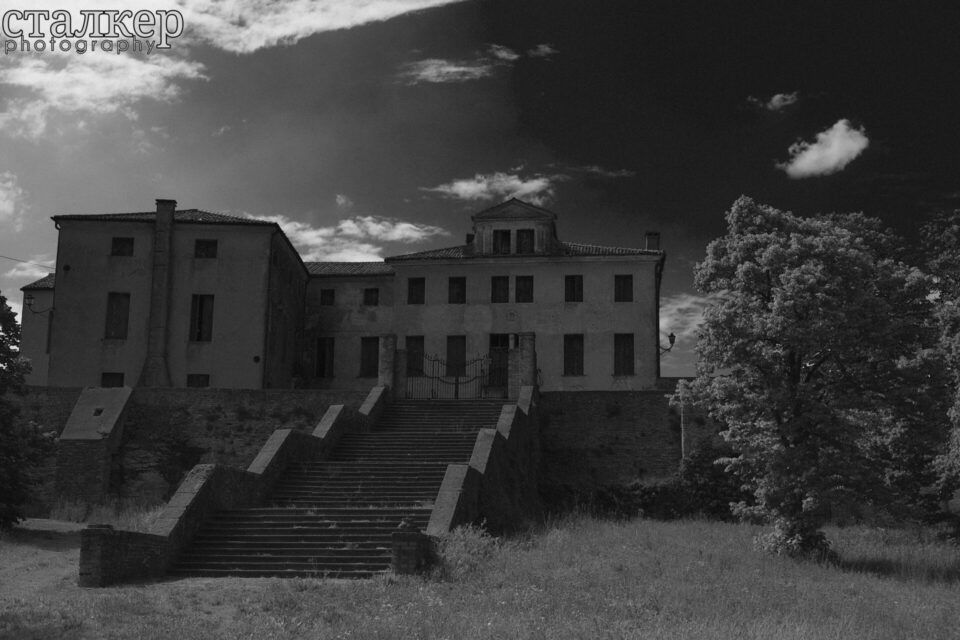
The villa sits deep in the countryside on the slopes of what was once Monte Buso, now largely destroyed by quarrying and replaced by Lago Azzurro. Villa Ca’ Barbaro is a Renaissance building from the 16th century, located in the municipality of Baone, at the southern edge of the Euganei Hills. In 2016, when I visited, exact directions were withheld — the post mentioned vandalism acts had occurred multiple times, and disclosing the location would only invite further damage. The villa is closed to the public, yet accessible enough to enter. Inside, the frescoes remained visible, though neglect had taken hold. The building exists in a state of semi-abandonment, caught between its Renaissance past and an uncertain future.
Historical Context
The villa is a residential complex of Renaissance origin, situated in Ca’ Barbaro locality in Baone, province of Padova, on the southern slopes of the Euganei Hills. A previous medieval building is documented at least from 1373, cited as the “casa merlata dei Macaruffi”.
In the 16th century, the area was assigned to the Salamon family — first messer Zuan Francesco, then his son Michele, and then his daughter Caterina, who married Francesco Molin. Through inheritance, the property passed to the Molin family, from which the historical name Ca’ Molin derives. Through marriages and succession, it was divided between the Correr and Barbaro families until the late 1700s, when the estate was united in the hands of the Barbaro family. The villa took its current name, and the entire surrounding area adopted it as well.
In the early decades of the 20th century, the villa was also cited as “Villa Breda” (property of engineer Breda). Subsequent owners were the Negrello family and Toniolo family.
The villa is located near the Bisatto Canal, a significant landscape feature of the region.

Decline and Abandonment
The documented history of this site remains unclear regarding the exact date of abandonment. The villa is now closed to the public and described as being in a state of semi-abandonment. Multiple vandalism acts have occurred at the site.
Reliable sources do not provide enough information to confirm the specific reasons for abandonment or the exact timeline. The landscape around the villa was profoundly influenced by extractive activity on the nearby hills — Monte Buso was transformed into a quarry.

What We Found
During the 2016 visit, the villa showed signs of long-term neglect. The interior still held visible frescoes from its Renaissance period, though damage and deterioration were evident. The building’s charm remained intact despite the decay.
The exact location was not disclosed in the original article due to vandalism concerns. The villa is situated approximately 4 km south of Baone’s center, at the extreme southern edge of the Euganei Hills.
The structure appeared to be a typical rural Venetian villa of its period, built for agricultural and residential purposes. The semi-abandoned state meant that while the building was not actively maintained, it had not yet been fully stripped or demolished.


After Our Visit
The villa remains in a state of semi-abandonment as of the latest available information. It is closed to the public, and the exact location continues to be withheld to prevent further vandalism.
The landscape around the villa has been profoundly altered — Monte Buso, on which the villa sits, was largely destroyed by quarrying and is now replaced by Lago Azzurro.
No demolition or redevelopment has been publicly documented. The 20th-century extractive activity that transformed the surrounding hills suggests the villa’s setting has been irrevocably changed, even if the building itself remains standing.