
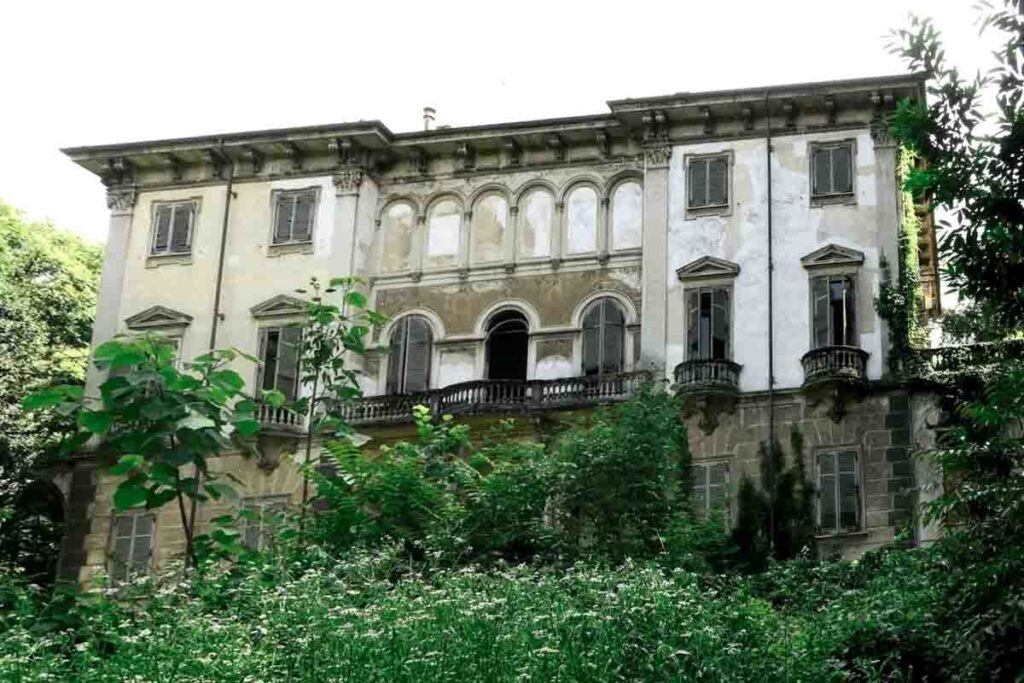
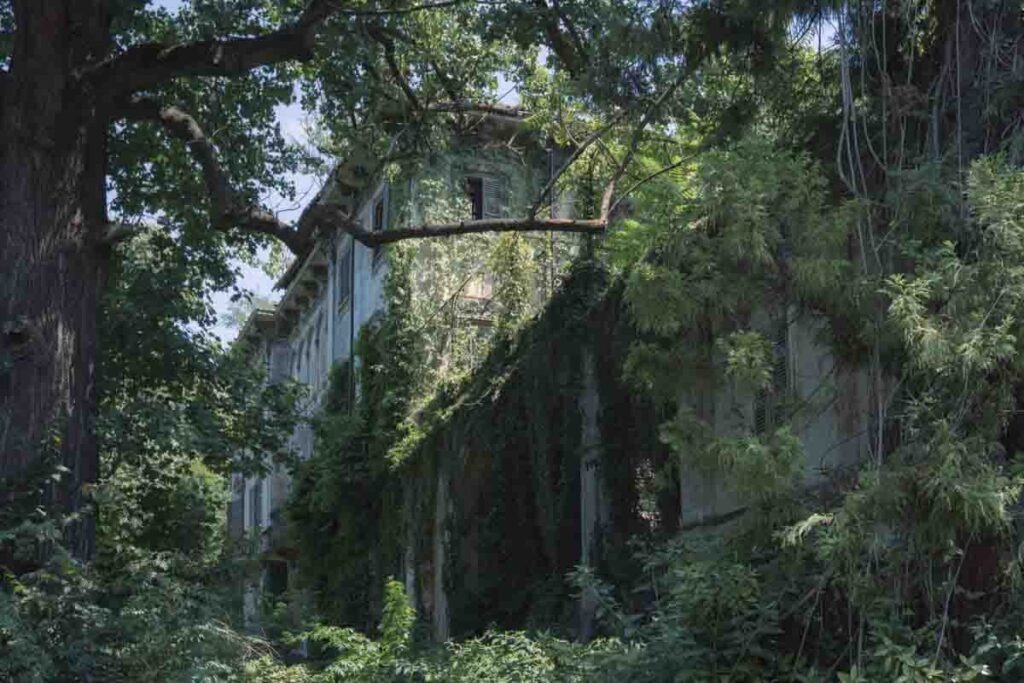
One nickname calls it the Villa of the Oracle. On a wooded rise above Turin, in the district of Val Salice, a Baroque residence has stood empty for more than three decades, reachable only by a steep footpath through nettles and chestnut coppice. Turinese call it, depending on who is telling the story, Villa Becker, Villa dell’Oracolo, or Villa delle Catacombe: three names attached to three different layers of a four-hundred-year history. Its official name is Villa Imperiali Becker, formerly Villa San Germano, and it stands on Strada del Righino, a few hundred metres from the Valsalice natural history museum: unexpectedly close to the city centre for a building this thoroughly forgotten. Behind its rusted gate survives not a ruin in the picturesque sense but a document: a seventeenth-century core reshaped in the early twentieth century by one of the city’s most significant Liberty architects, still holding, under collapsed ceilings and fire damage, the outline of a house built first for entertaining, then for privacy, then for nothing at all.
Historical Context
The land was bought in 1600 by Ludovico San Martino d’Agliè, a marchese from one of Piedmont’s oldest noble families; construction was largely finished by 1603. Ludovico lived here until his death in 1646, and the property (already associated by 1633 with his nephew Filippo d’Agliè) passed formally into Filippo’s hands.
The Favourite of Madama Reale
Filippo was no ordinary heir. He had met the Savoy regent Maria Cristina di Borbone-Francia, known as Madama Reale, at Cherasco in 1630, and from 1637 (the start of her widowhood) became her closest confidant, entrusted with orchestrating court life in Turin. Cardinal Richelieu’s hostility saw him briefly imprisoned in France; he returned to Turin in 1643 and, after Cristina’s death in 1663, spent his final years at the villa on the hill, dying in 1667. The estate then passed to a kinsman, the Abate d’Agliè, and under that ownership it was drawn into the Siege of Turin of 1706, when a contemporary diary records French troops briefly sighted near “the vineyard of the Reverend Abbot d’Agliè” before cannon fire from the hill’s forts sent them back. Period accounts call the property Saint Germain after Filippo’s fief: the origin of its later name, Villa San Germano.
The San Martino Agliè di San Germano family held the estate for two more centuries. Ownership then moved quickly through the nineteenth century: to Casimiro Rivoira, to Antonio Fornaca, in 1846 to the Prince of Lucinge, and in 1887 to the Isnardon couple.


An English Consul’s Italian Home
In 1902, Sir Walter Friederich Becker bought the villa. A British diplomat and businessman (Grand Officer of the British Empire and of the Crown of Siam, and eventually Siam’s Consul General in Turi) Becker had built his fortune as a shipowner trading between Messina and New Orleans before settling, after long stays in Florence, permanently in Turin. He made the villa his home and died there at seventy-three. Between 1903 and 1911 he commissioned the architect Pietro Fenoglio to rework the house — the renovation that gives the building much of its present character.

A Novelist Unimpressed by His Host
In 1919, Becker hosted David Herbert Lawrence, who described the villa’s beauty in a letter of 18 November that year to Lady Cynthia Asquith, while privately dismissing his host as a “parvenu.” Lawrence nonetheless drew on Becker and his wife for Sir Williams and Lady Franks, characters in his 1922 novel Aaron’s Rod, modelling their house on the Turin villa.
On Becker’s death in 1927, the estate passed to his widow, Delphine, who later remarried the Florentine marchese Demetrio Imperiali di Francavilla, thirty years her junior. Demetrio inherited the full Becker fortune on Delphine’s death and, by most accounts, spent much of it within a few years. His daughter Katie Boyle, who became a well-known British television personality, left a vivid, nostalgic account of the villa in her 1980 memoir, What This Katie Did.


Architecture and Space
Baroque Bones, Liberty Skin
What remains of the earliest building phase is likely the semicircular forecourt, its retaining wall lined with statues, and the small belvedere overlooking it. The house follows an elongated plan with projecting wings and a lateral entrance from Strada del Righino; eighteenth-century alterations were followed, in the mid-nineteenth century, by a more thorough remodelling of the central block, new side wings, and a garden reworked in the romantic taste of the period: laid out uphill across overlapping terraced hemicycles toward a final framed view. A wooded park of several hectares, with fountains and grottoes, still encloses the building on every side.
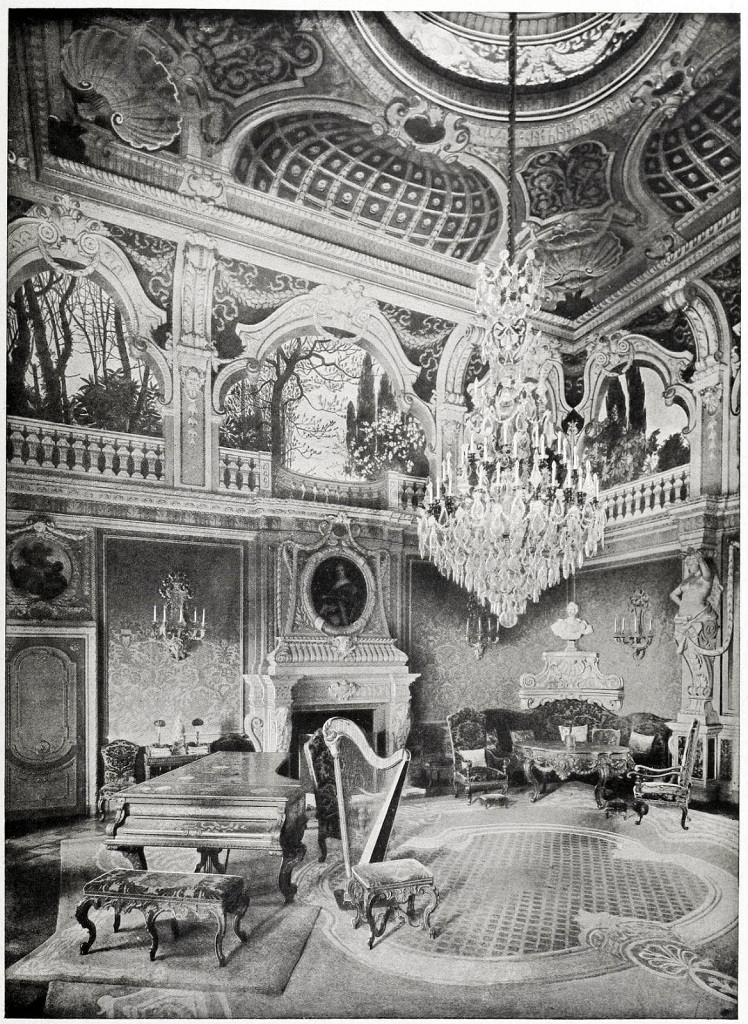
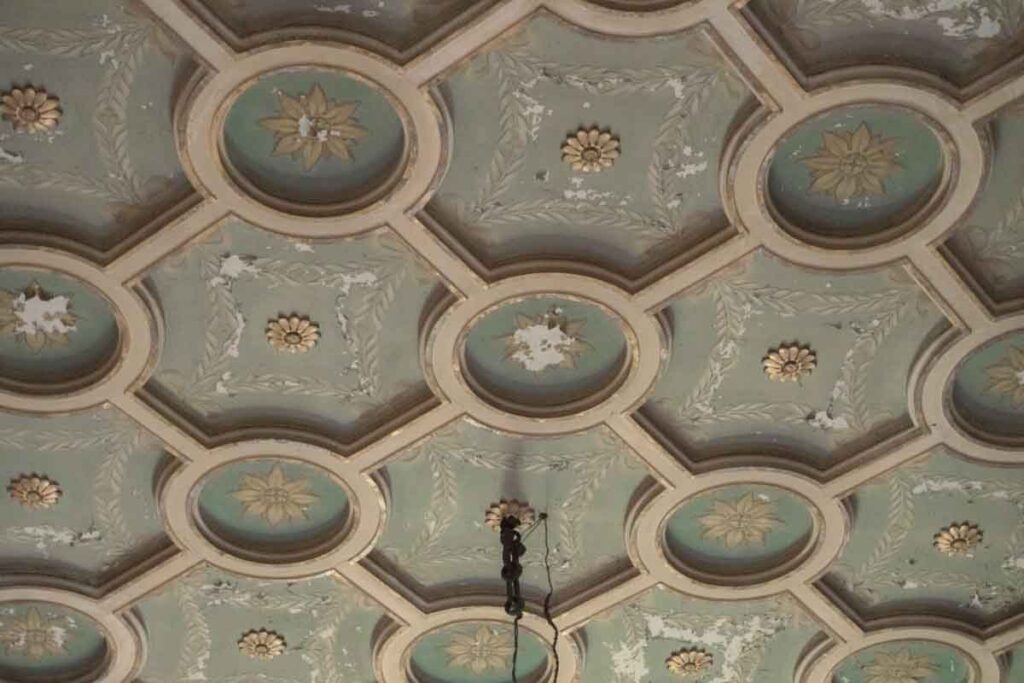
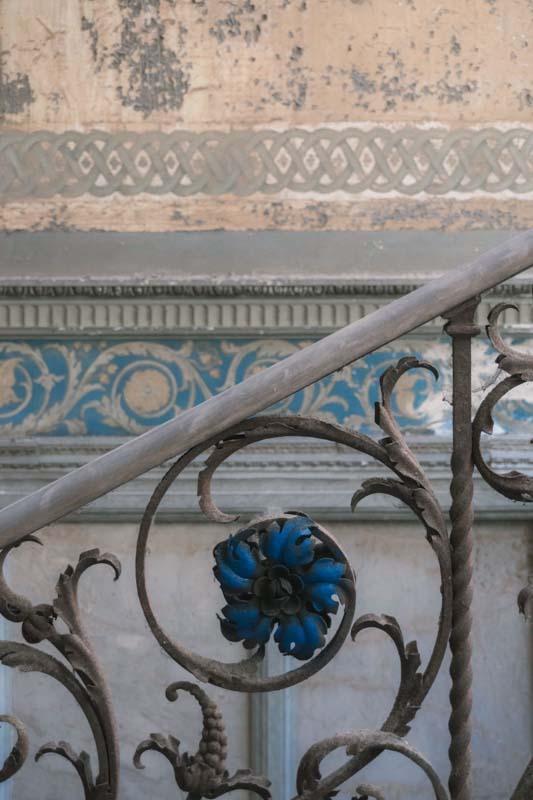
Fenoglio‘s 1903–1911 renovation layered Art Nouveau details onto this older structure (floral ironwork, decorative stuccowork, reworked openings) without erasing the Baroque skeleton beneath. What survives of the interior, documented in the municipal archive’s own photographs, includes a frescoed and stuccoed main salone with a built-in corner sofa, a grand staircase, an internal chapel, and a colonnaded portico. According to several published accounts, Becker had small dolphins worked discreetly into the salone’s stucco: a private pun on his wife’s name.
Decline and Abandonment
A Slow Emptying
Decline set in during the late 1980s. The villa was put up for sale by its private owners and has found no buyer since, despite carrying a heritage protection order from the Soprintendenza dei Beni architettonici e paesaggistici di Torino dating back to at least 1991.
Three Fires in a Week
In February 2022, the villa suffered three arson fires within days, gutting part of the attic and collapsing the ceiling in several rooms. The Piedmont Soprintendenza responded by demanding urgent safety works from the owner and did not rule out expropriation if further neglect followed. The heritage association UNIVOCA has pressed the same point in repeated formal appeals since 2021, most recently in 2023, after inspecting the extent of the fire damage firsthand.

What We Found
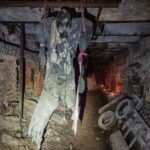
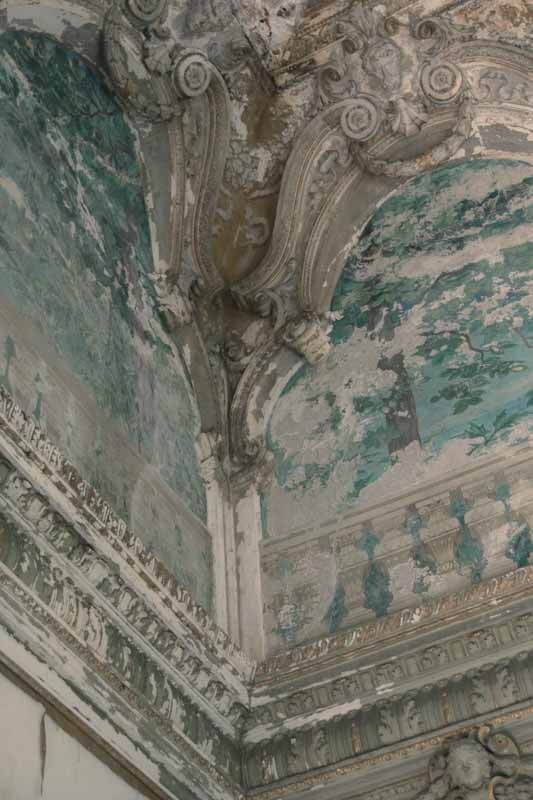
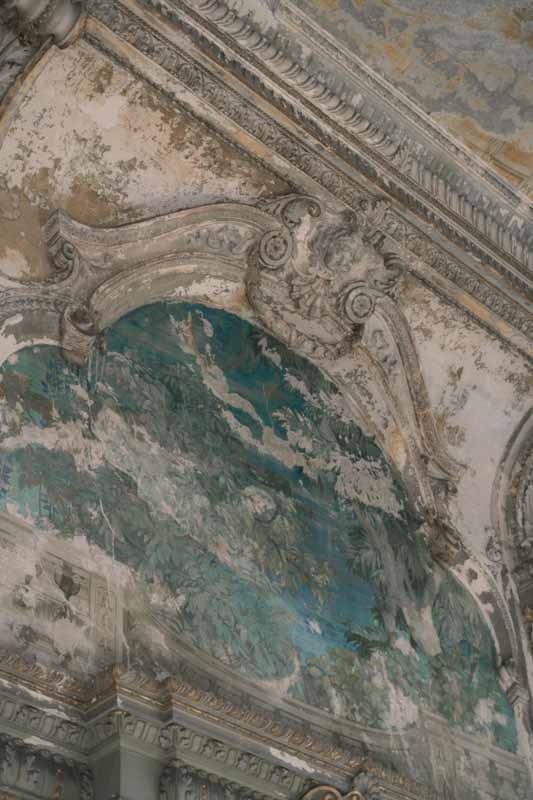
Behind the rusted gate, the ground floor still announces what the house once was: a vaulted, richly coloured ceiling on pointed arches carried by dozens of columns, an original fireplace, and, further in, the frescoed salone with its corner sofa and hidden dolphins, still faintly readable beneath decades of damp. The grand staircase survives, cracked and partly open to the sky where the roof failed above it; the small internal chapel keeps its shape if little of its decoration. Windows are boarded or simply gone, walls carry both graffiti and the black stains of 2022‘s fires, and the upper floors — where the fires did the worst damage — show collapsed ceilings and exposed beams. Signs of occasional shelter by homeless people appear alongside the ruin’s more romantic details, a reminder that abandonment here is not scenic but ongoing. Outside, the once-ordered garden of hemicycles has reverted to dense, almost equatorial undergrowth that hides the building from the road below and makes the short climb up the hill far harder than its length would suggest.

Current Status
As of the most recent published reporting, in 2025, Villa Becker remains privately owned and unrestored, its ownership still held by a real-estate company that has not found a buyer for the property. The fire damage from 2022 has not been repaired. Exchanges between the Soprintendenza and the ownership continue, reiterating requests for basic safety works, but no restoration project has been announced or begun. The villa is occasionally entered by homeless people seeking shelter and, less often, by explorers following the same steep path used by the film crew that shot here in 2006 for Dario Argento‘s La terza madre, released the following year: the film that gave the building its third nickname, Villa delle Catacombe.

Urbex location:
A big thank you to Soph for taking the photos.
Support the Archive
This independent archive is maintained without commercial sponsorship. If you find these materials useful, you can help keep it online.