
Origins
Stalker is an independent archive documenting abandoned places, disappearing architectures and transitional landscapes across more than 50 countries.
The project was founded in 2016 by Jacopo and Nastia at the crossroads of two different cultures and journeys. What began in a small apartment in Passau, Germany, as a simple side project slowly evolved into a long-term photographic and documentary archive built around travel, exploration and observation.
Over the years, Stalker has documented locations across Western and Eastern Europe, the Balkans, the Caucasus, Central Asia, Southeast Asia and other regions shaped by political, economic and social transformation.
Since 2022, the archive has been independently curated by Jacopo.
What the Archive Documents
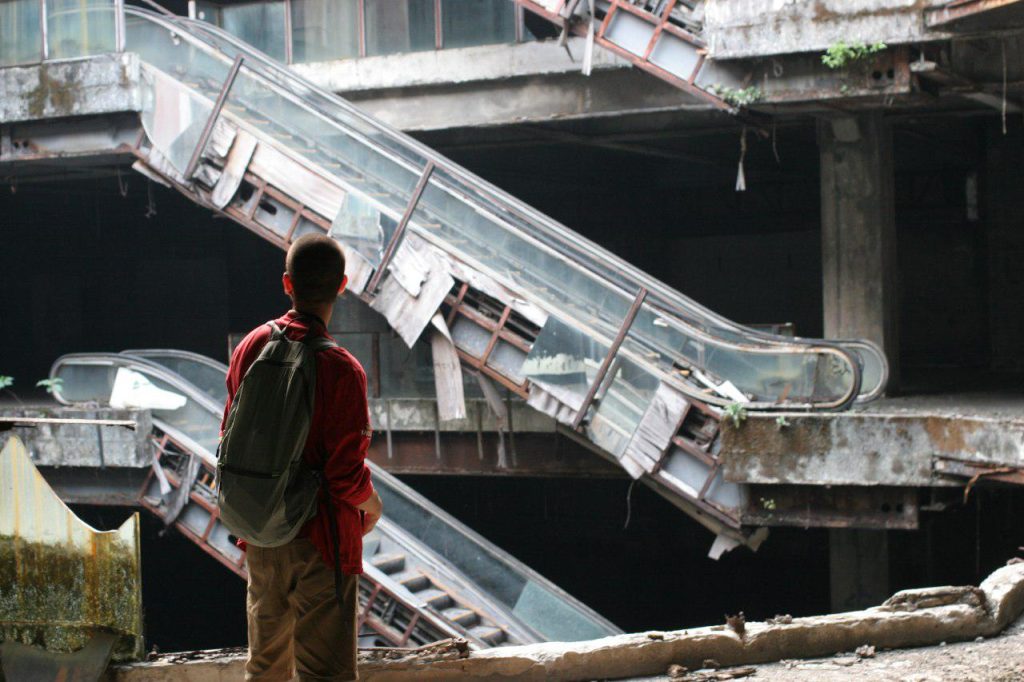
While many articles focus on abandoned architecture and urban exploration, the project is equally interested in the wider landscapes surrounding these places: borderlands, post-industrial territories, fading infrastructures, forgotten resorts, marginal environments and spaces suspended between decay and reinvention.
Many of the locations documented on this website no longer exist in their original form. Some have been demolished, renovated, repurposed or made inaccessible over time. As a result, the archive increasingly functions not only as a travel journal but also as a visual record of disappearing spaces and changing environments.
The project combines documentary photography, field research, and long-form writing, approaching abandoned places not as spectacles or “forbidden destinations” but as cultural and social landscapes shaped by memory, ideology, economic transition, and the passage of time.

Why “Stalker”
The name Stalker draws inspiration from Andrei Tarkovsky’s 1979 film and the science fiction novel “Roadside Picnic” by Arkady and Boris Strugatsky.
In these works, stalkers are not conquerors of forbidden places, but careful explorers of unstable and often mysterious zones existing at the edges of ordinary reality. They move through abandoned spaces with caution, respect and curiosity.
This idea deeply influenced the philosophy of the project.
For us, abandoned places are not trophies, playgrounds or backdrops for sensationalism. They are environments shaped by human history, ideology, collapse, transformation and memory. Many are fragile spaces that deserve observation rather than intrusion.
Whether documenting industrial ruins, sanatoriums, forgotten hotels, military remnants, collapsed factories or empty villages, the goal has always been to preserve traces of places slowly disappearing from the landscape.

Approach & Ethics
Stalker supports respectful exploration and documentation practices and does not encourage vandalism, theft or unsafe behaviour.
Some sensitive locations are intentionally described with limited geographical detail.
The archive prioritises observation, documentation and historical context over spectacle or “extreme exploration”.
The Archive Today
Over nearly a decade, the archive has grown into a large multilingual collection of articles, photographs and field notes documenting abandoned places and transitional landscapes around the world.
Part of the archive remains available in English, Italian and Russian. The Russian-language publication was gradually discontinued after Nastia departed from the project, although older materials remain accessible.

Collaborations & Licensing
Selected photographs and archival material may be available for:
- editorial licensing
- documentaries
- academic publications
- exhibitions
- research collaborations
For collaborations or inquiries, please use the contact page.
Support this project
This independent archive is maintained without commercial sponsorship. If you use materials or documentation from the archive for your research or projects, you can support its continued maintenance.