The Ferris wheel was turned by the wind, with no one on board.
Spreepark, formerly the VEB Kulturpark Plänterwald, occupies 29.5 hectares of wooded land in the north of the Plänterwald forest in the Treptow-Köpenick district of Berlin, adjacent to the river Spree. For the visitors who came during its years of abandonment — roughly 2002 to 2014, and officially accessible only through guided tours from 2011 — the defining image was the 45-metre Ferris wheel visible above the treeline, rotating slowly and silently in the wind. That Ferris wheel is no longer there: it was dismantled in 2021 and sent to Poland for restoration. The site itself is under active construction. But at the time of our visit, the park was still a ruin: fibreglass dinosaurs tipped at angles between the trees, a roller coaster emerging from the mouth of a concrete animal, a management booth where nobody sat, and that turning wheel above everything else.

Historical Context
Kulturpark Plänterwald: The GDR’s Only Permanent Park
The park was opened on 4 October 1969, the twentieth anniversary of the founding of the German Democratic Republic, under the name VEB Kulturpark Plänterwald. It was the only permanent amusement park in the entire GDR — and the only one in either East or West Berlin. At its peak, it drew 1.7 million visitors per year. Families arrived for the 40-metre Ferris wheel with its thirty-six cabins — at the time of its opening, the second-tallest in Europe after the one in Vienna — for carousels, roller coasters, a circus tent and open-air concerts. A herd of fibreglass dinosaurs purchased secondhand from a defunct French theme park became one of its most memorable features. Affectionately known as Kulti, the park was an integral part of GDR leisure culture for two decades. In 1989, for the fortieth anniversary of the GDR, the original Ferris wheel was upgraded to a 45-metre model with forty cabins. Less than two months later, the Berlin Wall fell.

Norbert Witte and the Privatisation, 1991
Following German reunification, the city of Berlin took over the VEB Kulturpark Berlin and sought a private operator to transform it according to Western market standards. Seven applicants submitted bids; in 1991 the contract was awarded to Norbert Witte, scion of a Hamburg carnival family and operator of the Spreepark Berlin GmbH. The lease specified that the land could only be used as an amusement park until 2061 — a clause that would later constrain every attempt to repurpose the site. What the city apparently failed to check thoroughly was Witte’s record: in 1981, while operating a travelling carnival in Hamburg, a crane he was using during repairs collided with a carousel called the Skylab, killing seven people and injuring fifteen. He was convicted of manslaughter. The Berlin Senate awarded him the contract regardless.
Under Witte, the park was renamed Spreepark and underwent a substantial transformation. New attractions were installed: a Western-themed area, an English Village, and a water landscape. Visitor numbers initially climbed to 1.5 million per annum. But the city’s decision to designate the surrounding Plänterwald a landscape conservation area prevented the construction of parking facilities that Witte needed to keep the park viable. As families from a reunified Germany gained access to newer and larger theme parks, visitor numbers began to fall. Rising ticket prices — admission reached 30 Deutsche Marks per person — accelerated the decline. By 2001, only 400,000 visitors entered the park in the entire year. In November 2001, Spreepark GmbH declared insolvency with debts of €11 million.

The Escape to Lima, the Flying Carpet, and Cocaine
On 18 January 2002, Witte, his wife Pia, his son Marcel and their closest associates left Berlin for Lima, Peru. Under the pretence of shipping attractions for repairs, they loaded six rides — the Fliegender Teppich (Flying Carpet), the Jet Star roller coaster, the Butterfly, the Spider, the Baby-Flug and the Wild River — into twenty shipping containers and sent them to South America. The plan was to open a new amusement park, a Lunapark, in Lima. It failed from the outset: several rides were confiscated by customs, others were damaged by the tropical climate, and the park never opened. The debts multiplied. With no other visible exit, Witte negotiated a deal with criminal contacts to smuggle 167 kilograms of cocaine — worth approximately €10–15 million — from Peru back to Germany, concealed inside the support mast of the Flying Carpet ride. One of his contacts was an undercover narcotics agent. In May 2004, Witte was arrested in Germany and sentenced to seven years in prison; he served four. His son Marcel, who had signed the shipping documents, was arrested in Peru and sentenced to twenty years by a Peruvian court in October 2006. “I’m responsible for it,” Witte said. “My son would have had nothing to do with such people. I have to live with that for the rest of my life.”
The park, meanwhile, was declared insolvent in August 2002 and left to deteriorate in the Plänterwald.

What We Found
The Main Roads
The park is surrounded by a high fence — no holes, small prongs on the top. My friend broke his trousers and some other clothes trying to cross it. So try to bring a soft jacket you can lie on the prongs when crossing. Once you’re in, try to avoid the main roads, as the guards could see you when patrolling the area. They say that when you’re caught, security asks for your passport data — so the second time they catch you, they’ll call the police and make you pay.
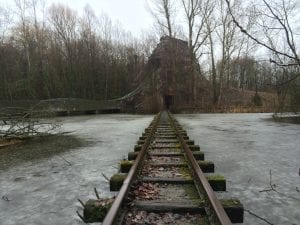
The Ferris Wheel That Still Moved
What is most amazing after you get inside is the huge Ferris wheel, which is still moving. Of course, with the help of the wind.

The Roller Coaster and the Management Booth
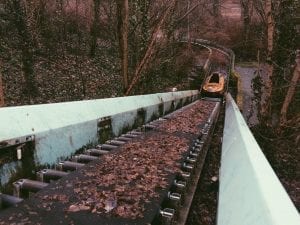
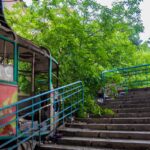
Going further, we found an old roller coaster leading out of a rabid-looking animal’s mouth. There were still some trailers and a management booth, so we just imagined that one of us was a park manager who allowed his friend to ride one attraction for free.
What Remains
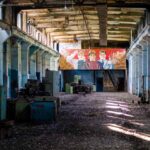
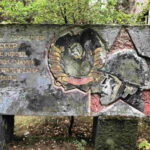
Some dinosaurs were lying broken, some wheels were still inviting you to ride, and a lonely rocket stood by itself. But nothing more.

Current Status
In March 2014, the City of Berlin bought the Spreepark for just over €2 million, and guided tours — which had been offered since 2011 — came to an end. On the evening of 10 August 2014, a major fire destroyed large parts of the park, including the English Village area; two blazes were discovered 200 metres apart, suggesting deliberate arson. In 2016, the city-owned company Grün Berlin GmbH was appointed to manage and develop the site. The concept that emerged from a multi-year public participation process — attended by some 2,000 residents — positioned the new Spreepark not as a traditional amusement park but as a hybrid cultural, ecological and artistic destination, operating under the motto Kunst, Kultur, Natur (Art, Culture, Nature). The Ferris wheel was dismantled in 2021, with parts kept for potential re-use. The wheel was sent to a specialist firm in Poland for restoration; renovations of the Ferris wheel are nearly complete, with the new 45-metre structure — using the gondolas from the original wheel — set to hang over a new water basin. The park’s reopening is now scheduled for 2027. The historic Eierhäuschen building on the Spree waterfront was reopened in late 2023 as a restaurant and exhibition space; its first restaurant operator closed at the end of 2025 due to low weekday footfall and delays in the main park opening. A new operator search was underway as of early 2026. The 2061 land-use clause in the original Witte lease has remained in force throughout, legally binding the site to recreational use regardless of who owns it.

Urbex location: