Ghosts of the past

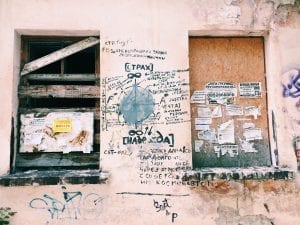
Boarded windows and open gate of the former mine-torpedo department building — Sevastopol

Almost every building in Sevastopol is somehow connected with the war. The defence of the city lasted exactly 250 days, so the Hitlerites during this time were occupying some of the houses in the city, leaving their traces… “Haunted House” in the heart of Sevastopol isn’t the exception.

The building known locally as the “Haunted House” stands on the Central Hill of Sevastopol, a city on the Crimean Peninsula whose political status has remained internationally disputed since Russia’s 2014 annexation of Crimea — a dispute not addressed further here. The building sits barely 200 metres from the city’s most prestigious school, the First Sevastopol Gymnasium, in the middle of one of the city’s oldest and most historically dense districts. Its windows are boarded, but the entrance gate has, at various points, stood open, making it one of the more accessible ruins in a city where almost every building carries some trace of war.

Historical Context

Built by the Man Who Rebuilt the City

Local history connects the building’s origins to Mikhail Kazi, a naval officer holding the rank of captain second class who served as Sevastopol’s city head between 1873 and 1876, in the years when the city was still recovering from the destruction of the Crimean War. Kazi is remembered as one of the key organisers of Russian shipbuilding and was later named an honorary citizen of Sevastopol for his role in the city’s postwar reconstruction. Heritage records place the construction of the building itself in the 1870s, close to but slightly earlier than the original 1880s date recalled locally; both dates place it firmly within Kazi’s era of civic rebuilding.

From Naval Office to Occupied Headquarters

After surviving two revolutions and a civil war largely intact, the building was given over to military use, housing the mine-torpedo department of what became the Black Sea Fleet. During the Siege of Sevastopol in the Second World War — a defence that lasted 250 days, from October 1941 to July 1942, before the city fell to German and Romanian forces — the building was occupied and repurposed by a unit of the German field gendarmerie, according to local accounts commanded by a Lieutenant-General named Ernst Schreve; some sources instead recall the building as having housed Gestapo or police functions during the occupation, and the exact command structure could not be independently confirmed beyond these overlapping local recollections. What is remembered consistently is what allegedly happened inside: prisoners reportedly tortured in the basements, and executions of communists and others deemed enemies of the occupying regime carried out in the courtyard, where a wall still bears bullet marks from that period.

Decline and Abandonment

Once the war ended, the building returned to its prewar function, again housing the mine-torpedo department of the Black Sea Fleet’s successor institutions until 1997. After the department’s departure, the building passed among various custodians without any undertaking restoration, and it deteriorated steadily over the following decades. Estimates place the cost of a full restoration at around 75 million rubles (roughly $1.3 million), a sum that, as of the most recent local reporting, has not been secured.

What We Found

The building of the former mine-torpedo department of the Red Banner Black Sea Fleet looked, from outside, like just another closed institutional building. But there is a little bit of philosophy to a building like this: the house has changed hands several times, and with each owner, someone died here.

Room Number Thirteen

There is a legend, according to which the house contains a room numbered thirteen. It exists, but no one has been able to find it — and the one person said to have managed it disappeared afterwards.

The Three Friends

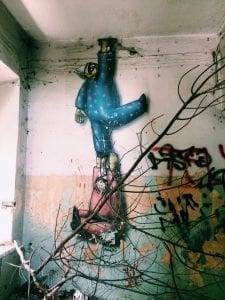
Inside the building, there are several pieces of graffiti. The most interesting, and the saddest, is a drawing of three little figures: on the second floor, one figure stands alone; on the first floor, two more figures hold that same figure’s hand, reaching upward. It is said that the graffiti commemorates three friends who hanged themselves in this house, though for reasons no one seems able to explain.

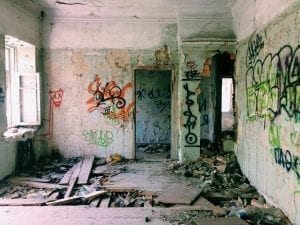
The building itself today looks very miserable. It stinks; a lot of rubbish is scattered around; the boards that once made up the floor are damp and rotting underfoot. The only visitors now are homeless people and young people who come here looking for a bit of extreme experience. Until recently, there was a beautiful iron frame on the second-floor balcony — it no longer exists, apparently taken away for scrap metal.

Current Status

At the time of writing, in 2026, the building’s situation has changed in one significant respect since it was first documented here. Local Sevastopol reporting indicates that within roughly the past two years, the building received formal heritage protection, being registered as an object of cultural heritage under the name “Dom Kleopina” (“Kleopin’s House”), with a sign now posted at the gate identifying it as privately guarded territory — a marked change from the open access described above. Despite this protected status, the same reporting describes the building as still standing in long-term neglect, alongside a second derelict heritage building nearby, with residents saying that repeated visits from officials and utility representatives have produced photographs and promises but no visible restoration work. No public record was found of the 75-million-ruble restoration ever having been funded, and no demolition plans were found either; the building’s legal protection as a heritage site means demolition is formally prohibited under Russian cultural heritage law, regardless of its physical condition.

Urbex location:

Leave a Reply