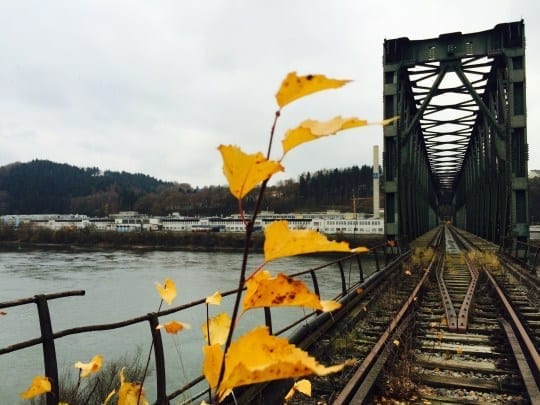
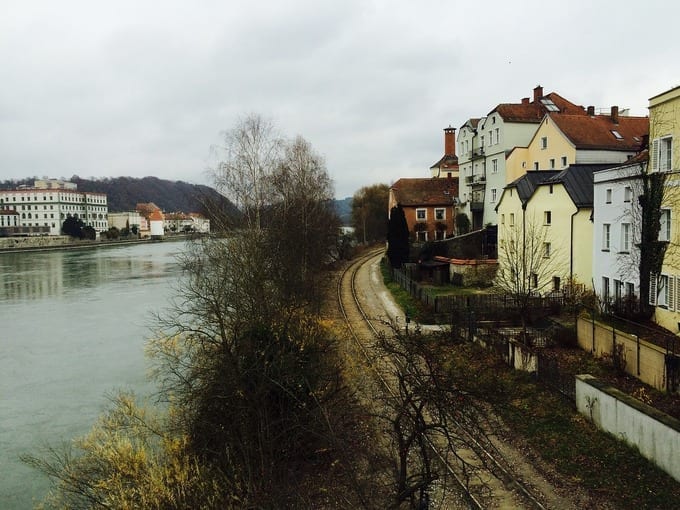
The railway track runs quietly through the Innstadt district of Passau, overgrown but still visible beneath layers of grass and moss. This is the Granitbahn, the local railway that connected Passau to Hauzenberg for nearly a century. In 2016, when I visited, it was the only abandoned site in my home city — a quiet scar of industrial history in a place most people walk past without noticing. The tracks lead toward the Kräutelsteinbrücke, the 280-meter bridge over the Danube that was destroyed in 1945 and rebuilt within the same year. Now the railway stands still, damaged by floods in 2002 and 2013, its future uncertain even as restoration efforts begin.
Historical Context
The railway was built between 1903 and 1904 to serve a region of the Bavarian Forest that depended on granite extraction and transport. Construction began in 1903, and the first train ran from Passau to Hauzenberg on 15 November 1904. The 25.11 km line climbed 177.7 meters in elevation, connecting the town of Hauzenberg — known for its granite quarries — to the main railway network at Passau.
The Kräutelsteinbrücke, the railway’s most significant structure, was built in 1903 by a construction company from Rosenheim. It crossed the Danube at river kilometre 2223.28, linking Innstadt on the right bank with Grubweg on the opposite side. During World War II, the bridge was destroyed in 1945 and was immediately rebuilt that same year. A general renovation followed in 1985.
A branch line extended from Erlau to Obernzell (opened 15 May 1909) and later to Wegscheid (1 December 1912), featuring a Strub rack railway system with 5,313 meters of rack length. This section climbed 370 meters over 15 km.
Decline and Abandonment
Passenger service ended in September 1970, after nearly 66 years of operation. Special trains organised by the Passauer Eisenbahnfreunde (Passau Railway Friends) began running in 1978. Goods traffic continued longer, ending at Hauzenberg on 1 June 1997 and at Obernzell around the 2000–2001 New Year.
The decisive event was the catastrophic flood of 2002, which damaged the track severely enough that rail service could no longer continue. Another flood in 2013 caused additional damage. The line was formally closed in 2007. The Bavarian Regionaleisenbahn (BRE/DRE) leased the track on 24 November 2007 and purchased it from DB in December 2014.
What We Found
During the 2016 visit, the railway showed clear signs of long-term abandonment. The tracks were covered in vegetation, with grass and moss growing between the rails. Flood debris from 2002 and 2013 remained visible at certain points along the line. The Kräutelsteinbrücke stood silent, its steel structure weathered but intact after decades of disuse.
Station buildings along the route showed broken windows and deteriorating facades. The track bed was filled with silt and sediment from the floods, requiring extensive clearing work that would not begin for years. At Passau-Voglau, the switching point where trains had to reverse direction to access the branch line, the infrastructure remained in place but unused.
The ramp toward Hauzenberg climbed steeply — the line had a 1:40 gradient — and this section showed particularly heavy overgrowth. The railway was not completely cleared until 2010, when the entire route was first cleared of vegetation.


What We Found
During the 2016 visit, the railway showed clear signs of long-term abandonment. The tracks were covered in vegetation, with grass and moss growing between the rails. Flood debris from 2002 and 2013 remained visible at certain points along the line. The Kräutelsteinbrücke stood silent, its steel structure weathered but intact after decades of disuse.
Station buildings along the route showed broken windows and deteriorating facades. The track bed was filled with silt and sediment from the floods, requiring extensive clearing work that would not begin for years. At Passau-Voglau, the switching point where trains had to reverse direction to access the branch line, the infrastructure remained in place but unused.
The ramp toward Hauzenberg climbed steeply — the line had a 1:40 gradient — and this section showed particularly heavy overgrowth. The railway was not completely cleared until 2010, when the entire route was first cleared of vegetation.
Urbex location: