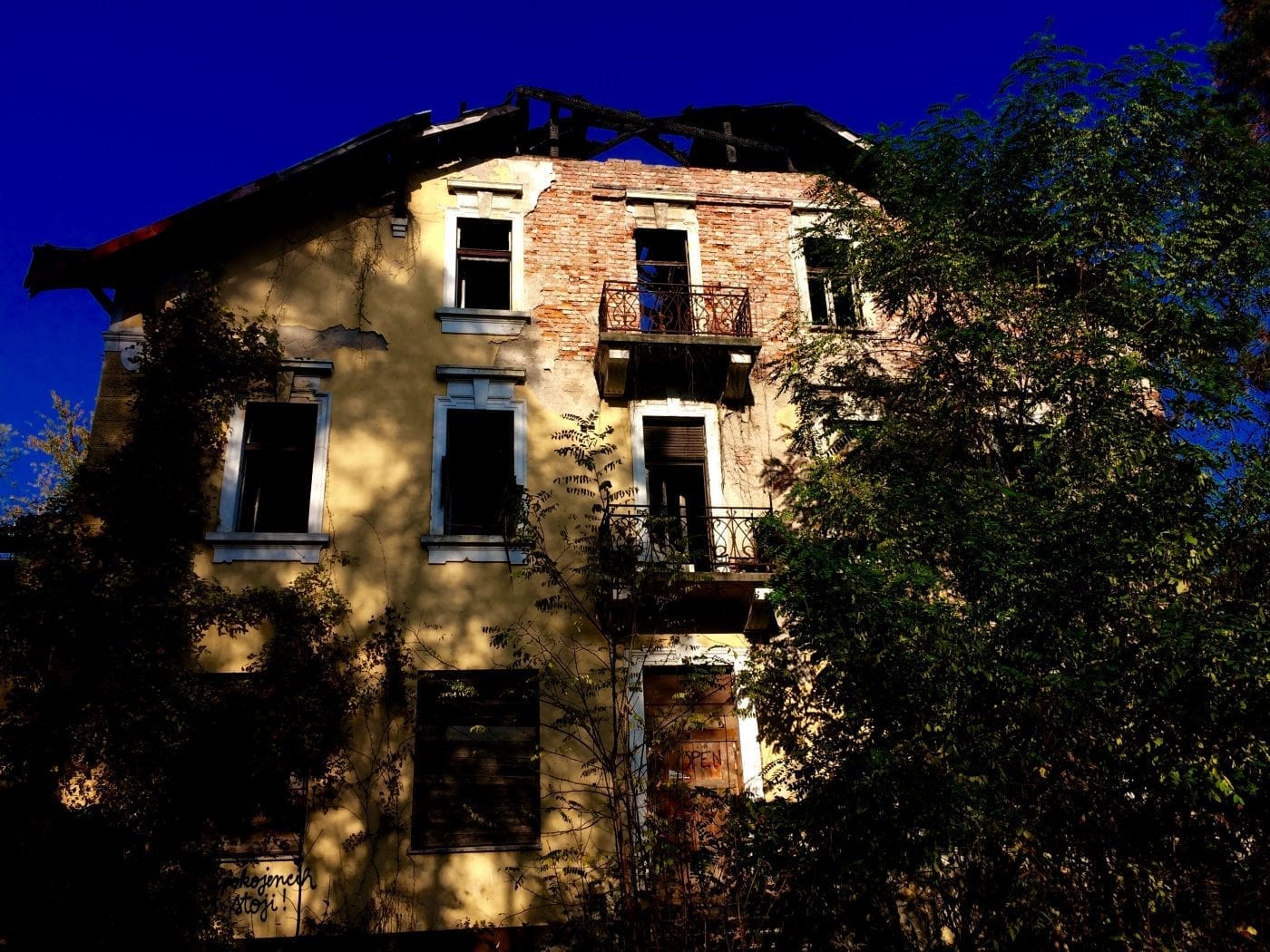
On the slope of Šišenska hill, above Celovška cesta and near Tivoli Hall, stands what remains of the Hotel Bellevue. Built in 1909 in Secession style, the hotel once matched the grandeur of Ljubljana’s centre. In 2016, when I visited, it was already a ruin — broken windows, stripped interiors, graffiti covering walls that had once held ornate window surrounds and wrought-iron fences. The building sat inside Tivoli Park, just five minutes from the old town, yet locals walked past without paying attention. Fires in 2006 and 2014 had destroyed the roof, accelerating the decay that would end with demolition in 2025.
Historical Context
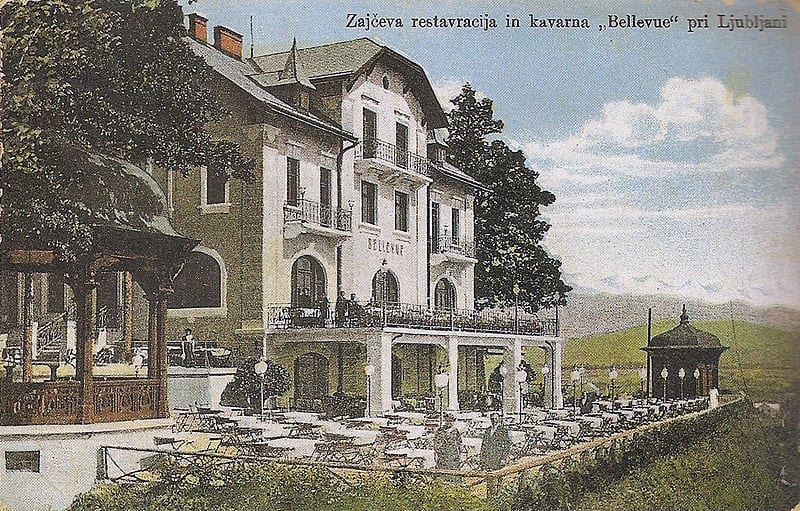
The hotel was built in 1909 by Alojzij Zajec, a wine trader from Šišenka, on the site of a former wooden café that he had purchased and demolished. The Secessionist (Art Nouveau) building featured characteristic elements: window surrounds, wrought-iron fences on terraces, balconies and the pavilion, and kandelabriers with etched-glass lamps.
In 1912, Johan Friedl rented the building. In 1928, Zajec sold the hotel to the Šterk family, who owned it until 1953. The hotel served the city for decades — in 1935, one of the first jazz orchestres in Ljubljana played in the hotel’s pavilion. In 1967, a preparatory committee for forming a barman section was established here, the predecessor of today’s Society of Bartenders of Slovenia.
In 1953, the Yugoslav Government nationalised the hotel. It was owned by Gostinsko podjetje Vič during the socialist period.

Decline and Abandonment
After Slovenia’s independence in 1991, the hotel was abandoned. In 2001, it was returned to denationalisation beneficiaries — the Šterk family. In 2005, the heirs sold it to Študentski servis Maribor, and the hotel became a nightclub/dance club.
Two fires devastated the building: February 2006 and May 2014. Both destroyed the roof (ostrešje) and accelerated decay. In 2007, the hotel was declared a cultural monument of local importance — yet it remained abandoned.
In 2009, the property was sold to Mawared International, a Jordanian state fund, which planned partial restoration and new construction. After eight years, Mawared sold it to businessman Izet Rastoder. In 2017, the heavily damaged object with its ugly surroundings ended up in the ownership of Rastoder’s company.
What We Found
During the 2016 visit, the hotel showed extensive long-term abandonment. Much of the interior was covered in graffiti and stripped of possessions. Broken windows marked the exterior facade. The Secessionist architectural details — window surrounds, wrought-iron fences — were still visible but deteriorating.
There were outbuildings including impressive bandstand-style shelters and a more modern extension to the rear. Evidence of someone living in one of the inner rooms was visible — a temporary inhabitant among the decay.
The roof damage from the 2006 and 2014 fires was apparent. The building sat in Tivoli Park’s over 13,000m² of parkland, just 5 minutes walk from the centre. Despite being so close to the grand centre, entry was easier than expected — the building had been left accessible.


After Our Visit
The situation changed dramatically after 2016. In late 2017, the damaged hotel was sold to Rastoder’s company Bellevue Investicije. Restoration work was planned but delayed — by May 2025, the building permit would have expired if work didn’t begin.
Between April and September 2025, Rastoder’s company demolished the dilapidated hotel. The building permit foresees the construction of a replacement object that should be externally identical to the original.
The hotel no longer exists. A replica will be built on its site, but the original 1909 building — with its Secessionist details, its history as a jazz venue and barman training site, its decades of decay — is gone.
Urbex location:


