More than three decades after the structural cataclysm of the Yugoslav Wars, the urban fabric of Mostar remains a fragmented palimpsest of conflict. While the internationally funded restoration of the historic Ottoman core draws thousands of transients daily, a parallel city of concrete skeletons and perforated brickwork endures just beyond the tourist perimeter. Mostar, the cultural capital of the Herzegovina region, functions as an open-air archive of trauma, where the material ruins of the 1990s are deeply integrated into the spatial routines of contemporary civic life.
Historical Context
The contemporary state of abandonment in Mostar is the direct consequence of two distinct, overlapping conflicts that comprised the Siege of Mostar between 1992 and 1994. Following the declaration of independence of Bosnia and Herzegovina from the Socialist Federal Republic of Yugoslavia, the initial phase of warfare erupted in April 1992. This period saw an uneasy alliance between the Croatian Defence Council (HVO) and the Army of the Republic of Bosnia and Herzegovina (ARBiH) operating against the Serb-dominated Yugoslav People’s Army (JNA) and paramilitary units. The JNA forces occupied the surrounding hillsides, subjecting the city below to indiscriminate artillery bombardment. This first siege concluded in June 1992 with the execution of Operation Jackal by the Croatian Army (HV) and the HVO, which successfully pushed the Serb forces eastward across the Neretva River. The structural and demographic toll was immediate: approximately 90,000 residents fled the municipality, and a significant portion of its historic, cultural, and religious infrastructure was severely compromised.
By the spring of 1993, shifting geopolitical alliances fractured the defensive coalition, initiating the brutal Croat-Bosniak War. Between June 1993 and April 1994, the HVO launched a secondary siege against the Bosniak-concentrated eastern sector of the city. This phase transformed the urban environment into a hyper-militarized zone of attrition. Humanitarian aid channels were systematically obstructed, ten historical mosques were severely damaged or entirely leveled, and on November 9, 1993, the iconic 16th-century Stari Most bridge was shelled into the Neretva River. Formal hostilities ceased with the ratification of the Washington Agreement in March 1994, which codified the Croat-Bosniak Federation, yet left the city structurally shattered and ethnically segregated.

Architecture and Space
The most imposing architectural monument to this violence is the structural shell locally designated as the Sniper Tower. Designed by the Yugoslav architect Dragan Bijedić and completed in the late 1980s, the structure originally functioned as the regional headquarters for the Slovenian financial institution Ljubljanska Banka. Visually, the building is an exemplar of late-socialist Yugoslav modernism, characterised by its rigorous geometric concrete framework, expansive glazing, and structural verticality that deliberately asserted a sense of institutional permanence at the intersection of the city’s key thoroughfares, Bulevar and Ulica Kralja Zvonimira.
During the second siege, the building’s architectural assets—specifically its height as the tallest structure in the immediate vicinity and its strategic location near the riverbanks—dictated its militarization. Positioned firmly within Croat-controlled western territory, the bank provided an unobstructed, elevated view across the Neretva valley directly into the residential quarters of East Mostar. The modernist office windows were hastily retrofitted into defensive bulkheads, transforming a symbol of financial integration into an optimized platform for marksmen. From these concrete voids, snipers terrorized the civilian population below, turning basic survival tasks like gathering water or crossing streets into lethal gambles. The tower effectively functioned as a concrete apparatus of ethnic segregation, enforcing the division of the city through ballistic force.

Decline and Abandonment
The lingering paralysis of Mostar’s architectural revitalisation is deeply tied to the complex post-war legal landscape. Under current heritage frameworks, any structurally compromised building designated to possess historical or architectural value is subject to strict preservation laws that mandate exact reconstruction to its pre-war state. Because the city’s historical urban fabric was characterised by rich, complex craftsmanship, and the scale of wartime devastation was profound, authentic structural restoration demands significant capital expenditure. The municipal and national authorities routinely lack the financial resources to fund these complex public works, while the absolute legal prohibition on demolition prevents private developers from clearing the land for speculative modern builds. Consequently, the legal protections intended to preserve memory have instead institutionalised a state of spatial suspension, forcing the post-war populace to reside within a landscape of permanent ruins that continually echo the architectural trauma of the conflict.

What We Found
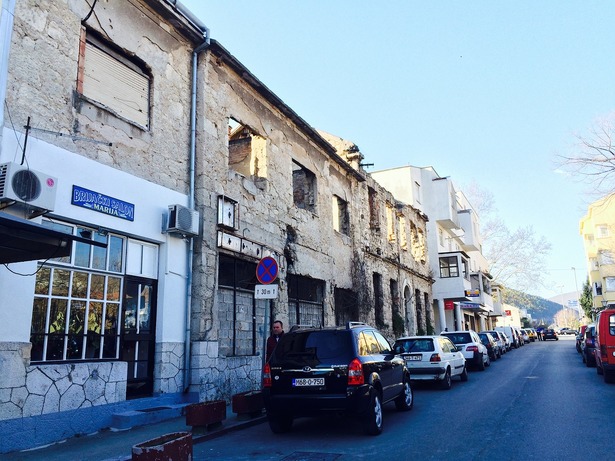
In Mostar, the density of abandonment remains remarkably high, with nearly every third structure displaying some degree of war damage or total structural neglect. Accessing these spaces is notably uncomplicated; the vast majority of the ruins lack peripheral fencing, security personnel, or physical barriers. While municipal authorities have affixed weathered warning signs cautioning passersby against the threat of structural collapse and explicitly prohibiting entry or nearby vehicular parking, a palpable civic indifference prevails. Residents routinely park their passenger vehicles directly beneath crumbling facades and exposed concrete lintels.
The interior of the former Ljubljanska Banka functions today as a vertical gallery of political and subcultural expression. The concrete surfaces of the lower floors are heavily layered with graffiti, murals, and anti-war iconography left by local and international street artists. Navigating the ground plane requires cautious movement; the floor is densely littered with decades of accumulated debris, including shattered glass, calcified concrete dust, rusted rebar, and the decayed remnants of 1980s office equipment. While the interior space has undergone sporadic municipal clean-ups to remove the most hazardous detritus, the physical ascent through the open stairwell remains hazardous due to the complete absence of guardrails or window panes. The upper tiers of the concrete frame offer an expansive, panoramic vista of the divided city, exposing the stark spatial contrast between the Catholic crosses dominating the western hills and the minarets punctuating the eastern skyline.


Current Status
As of 2026, the Sniper Tower stands entirely unreconstructed, a towering monument of raw concrete exposed to the elements. While the surrounding historic core has achieved deep commercial revitalisation under its UNESCO World Heritage designation, the former Ljubljanska Banka remains in an administrative and physical limbo. No definitive plans for its structural rehabilitation, conversion into a formal memorial museum, or adaptive reuse have been executed by local authorities. The building persists primarily as an alternative tourist site and a silent, concrete witness to the unresolved sociopolitical fractures of the post-Yugoslav landscape.