Hidden in the wooded landscape of Stojčevac, a recreational area on the outskirts of Sarajevo, stands the burned remains of a structure that local accounts continue to associate with one of the most enigmatic figures of twentieth-century Balkan history: Josip Broz Tito.
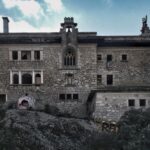
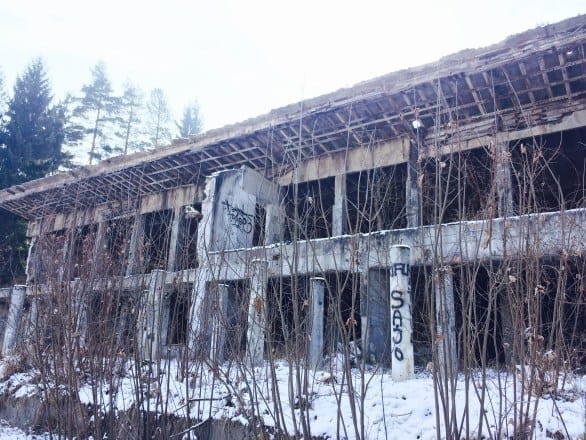
The expectation surrounding a place connected, even informally, to the former Yugoslav president naturally evokes images of state grandeur: guarded compounds, monumental architecture, polished interiors, ceremonial halls. What we encountered instead was something radically different. Perched above the surrounding parkland were only the charred ruins of a destroyed structure, its walls vandalised, partially collapsed, and stripped almost entirely of any trace of former prestige.
Yet the remains above ground turned out to be only a fragment of what this site once represented.
Beneath the ruined building, concealed behind a modest depression in the terrain, lay the entrance to a vast underground system whose scale immediately shifted our understanding of the place entirely.
Historical Context
The exact history of this site remains difficult to verify. Unlike better-documented Yugoslav military structures such as ARK D-0 Nuclear Bunker — the massive Cold War atomic shelter near Konjic built to protect Yugoslav leadership during nuclear conflict — remarkably little publicly available documentation exists regarding the Stojčevac complex.
Residents themselves were unable to provide definitive information concerning its date of construction, the institutions responsible for building it, or the exact function it once served.
According to accounts gathered locally during the exploration, the structure was allegedly constructed as a protected wartime refuge connected to the personal security infrastructure surrounding Tito during the decades of the Cold War.
Such an interpretation would not be entirely implausible. During the existence of the Socialist Federal Republic of Yugoslavia between 1945 and 1992, state authorities invested heavily in dispersed underground military infrastructure intended to guarantee continuity of command in the event of foreign invasion or internal instability.
Tito’s better-known official residence stood in Zagreb, today known as Villa Zagorje, a presidential complex now used by Croatian state institutions. But Yugoslavia’s security doctrine frequently relied on secondary protected facilities distributed across strategically important regions.
If local accounts are accurate, the Stojčevac complex may have formed part of that broader defensive network.
Because archival documentation remains scarce, however, its precise historical role cannot currently be verified with certainty.

Architecture and Space
From the exterior, very little remains to suggest the strategic significance the structure may once have possessed.
The ruined building sits elevated above the surrounding terrain, overlooking the wooded recreational area of Stojčevac near the district of Hrasnica, southwest of Sarajevo. Fire damage has devastated much of the visible structure, leaving behind skeletal walls and fractured concrete surfaces now covered by graffiti.
The architecture above ground appears utilitarian rather than ceremonial. If the building indeed functioned as a protective residence or military support structure, the modest exterior would have served an obvious purpose: concealment.
The true scale of the site reveals itself underground.
Behind the ruined upper structure, a recessed opening leads to a staircase descending sharply into the earth. The descent continues for what felt like nearly a thousand steps, eventually opening into a subterranean network whose dimensions far exceed what the surface architecture suggests.
The underground system appears to have been engineered for endurance: reinforced corridors, directional signage, multiple exit routes, acoustic efficiency and apparently extensive tunnel networks extending far beyond immediately accessible sections.
Decline and Abandonment
No verified documentation currently explains precisely when the Stojčevac complex ceased functioning.
The broader collapse of Yugoslavia during the early 1990s, followed by the devastating Bosnian War (1992–1995), profoundly transformed military and governmental infrastructure throughout Bosnia and Herzegovina.
Numerous former state facilities were abandoned, destroyed intentionally, looted, or left without institutional oversight.
The visible fire damage affecting the upper structure suggests either deliberate destruction, vandalism over time, or deterioration accelerated by years of neglect. The substantial accumulation of garbage inside the tunnels indicates repeated unauthorised access over many years following abandonment.
Today, the site appears largely unsecured and vulnerable to continued deterioration.
What We Found
As we mentioned before, the first thing we saw after arriving was a ruined and burnt house that didn’t resemble the royal palace of the great president of Yugoslavia. Only wreckage dominated the landscape from the top of the hill.
We walked a little further inside the building and immediately noticed a small indentation in the structure. There, hidden almost casually, were stairs leading down… down… down. Maybe a thousand steps.
After finally overcoming the descent, we were swallowed by darkness.
Thanks to the excellent acoustics, we could hear the voices of our travel companions somewhere far behind us. Honestly, that became the only thing stopping the atmosphere of this place from becoming genuinely frightening.
Below us stretched the tunnel.
Really long.
Hundreds of kilometers perhaps. During the hour we spent underground, it felt as if we had seen only a quarter of the entire system.
Inside, we found numerous directional signs showing routes deeper into the complex and ways back toward the surface. We never trusted them. Instead we created our own improvised navigation system, leaving bottles behind us pointing toward the direction we had entered.
The ground — not floor — was covered almost entirely by garbage of every kind.
Meanwhile, darkness, winter cold and humidity were doing their best to test both our bodies and our minds.
After nearly half an hour underground, we discovered a secondary exit leading toward another ruined section opening directly into the park. Still, we decided to keep going deeper.
After one of the corners, we found a small room with another staircase leading upward.
The stairs looked extremely old.
And extremely high.
We decided not to risk climbing.
Later, our friends told us that someone they knew had once gone all the way up. The ascent reportedly took nearly twenty minutes.
At the top?
A helipad.
Inside this same room, we also discovered the remains of a strange, dead animal.
Locals later told us it had been a wolf sacrificed there.
To us, it looked simply like a dead dog.
Current Status
As of 2024, the abandoned underground complex in Stojčevac, near Sarajevo, remains publicly accessible and continues to deteriorate.
No publicly available municipal records currently indicate any active restoration, heritage protection designation, or redevelopment plans connected to the structure.
The upper building remains severely fire-damaged and heavily vandalised, while the underground sections continue to accumulate debris from repeated unauthorised access.
Due to the absence of formal documentation, the site remains one of the more obscure and poorly documented remnants of the former Yugoslav-era underground infrastructure in Bosnia and Herzegovina.