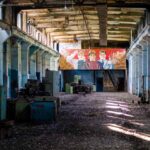

A few kilometres from Shenyang, in northeastern China, lies an abandoned complex that seems to come from another era.
The project was conceived during the real estate boom of 2010, when the construction rush transformed vast areas of the country into permanent construction sites. In Shenyang, the giant Greenland Group purchased a large tract of land and unveiled an ambitious plan: 260 villas surrounded by a golf course, a hotel, and a conference centre. The floors were marble, the chandeliers crystal, and the interiors opulent and inspired by 19th-century European residences.
It was a dream built for an elite that never got to live there.


The rise and fall of Greenland Group
Greenland Group was one of many Chinese real estate companies that found themselves overwhelmed by debt in the years that followed. Over $220 million was invested in the State Guest Mansions project, but only 5% of the homes were sold before construction was halted in 2018.
The reasons for the abandonment were never officially clarified, but there is no shortage of hypotheses.


Why are ghost towns in China
According to many analysts, the crisis in China’s real estate sector—and the proliferation of unfinished projects, dubbed Rotten Tail Buildings—is linked to the strict anti-debt measures introduced by the government in 2020. These restrictions, designed to curb speculation, have led to the collapse of many construction companies, leaving millions of homes incomplete and unsold.
It is estimated that there are around 65 million empty homes in the country, equivalent to over 230 million square meters of abandoned or unfinished buildings.
However, many also blame local corruption and the crackdown on uncontrolled construction practices, which intensified under Xi Jinping’s presidency. Since then, the ostentatious display of wealth has become socially frowned upon, and projects like this have fallen by the wayside.


Exploration: between marble villas and cornfields
I arrive at 10 a.m., after a long taxi ride from downtown Shenyang. I ask to be dropped off at the main entrance: a large closed gate, guarded from a distance. As soon as a car leaves the complex, I seize the moment to walk around the fence.
Under some metal sheets, I find an opening wide enough for two people to pass through. I slip inside and, a few seconds later, find myself face to face with the abandoned villas: stately facades, empty windows, and a surreal silence. In the distance, I see movement: a parked car, a few men talking. I crouch down and make my way through the cornfields—now cultivated by local farmers who have converted the gardens into agricultural fields.
The ancient villas of the wealthy have become stables and warehouses. Goats and cows graze among the marble columns, while farmers pile bales of hay inside the double garages. Even the complex’s artificial lake is now a pond used for irrigation.


I go upstairs to avoid some rather large stray dogs wandering around. Inside the main buildings, I find chandeliers, paintings, and furniture covered in layers of dust. Some rooms look like something out of Versailles: inlaid tables, gilded chairs, faded velvet curtains.
In a large palace, I meet three Chinese explorers, who are as surprised as I am. They ask me a few quick questions, then continue filming.
In the central building, I discover administrative documents, vintage photographs, Christmas decorations, and even a three-dimensional relief of the entire complex. After three hours of almost complete exploration, I leave the site with the feeling of having passed through a fragment of recent history: a silent monument to the fall (fortunately, I might add) of Chinese real estate dreams.


Urbex location: