Half the tracks are buried under sand, and the platforms haven’t seen a train in nearly four decades.
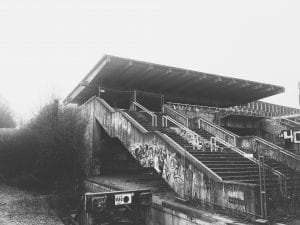
The München Olympiastadion station sits on the western edge of the Olympiapark in northern Munich, enclosed by a fence and gradually being reclaimed by vegetation. It was built for a summer that lasted seventeen days and has been standing empty ever since. From the outside, it looks like something the city simply mislaid — a concrete platform structure visible from the road, graffitied, overgrown, with the tracks that once connected it to the main network long since cut. It is one of the most unusual pieces of Olympic infrastructure still standing in Europe, and one of the least visited.

Historical Context
The Games Munich Wanted
Munich was awarded the 1972 Summer Olympics on 26 April 1966 at the 64th IOC Session in Rome, beating out Detroit, Madrid and Montréal. The intent behind the Munich bid was partly symbolic: West Germany wanted to demonstrate, through an open and architecturally forward-looking Games, that the country had put the 1936 Berlin Olympics behind it. The Olympiapark that emerged from this intent was designed by the firm of Günter Behnisch with the tensile roof structure conceived by engineer Frei Otto — a sweeping canopy of acrylic glass stabilised by steel cables, covering the stadium, the hall and the swimming venue, considered revolutionary at the time and costing 1.35 billion German marks in total. The Games opened on 26 August 1972 with 121 National Olympic Committees and 7,134 athletes represented.

5 September 1972
What the Munich Games are remembered for most is not the architecture. On the morning of 5 September 1972, eight members of the Palestinian militant organisation Black September infiltrated the Olympic Village, killed two members of the Israeli team and took nine others hostage. The standoff lasted nearly eighteen hours. A failed rescue attempt at Fürstenfeldbruck Air Base ended with all nine remaining hostages dead, along with one West German police officer and five of the attackers. The Games were suspended for thirty-four hours, a memorial service was held in the Olympic Stadium, and IOC President Avery Brundage famously declared that the Games must go on. The Munich massacre killed eleven Israeli athletes and coaches in total. It was the first terrorist attack to be broadcast live to a global audience, watched by an estimated 900 million people.
The Station Built for Sixteen Days
The S-Bahn station was built in the early 1970s and opened on 26 May 1972 — three months before the Games began — to provide supplementary rail capacity alongside the U-Bahn network then under construction. Its layout was substantial: two island platforms with four tracks in total, two of which terminated at the station while the remaining two continued further south toward the Münchner Nordring freight line. During the Games, it was used intensively, drawing crowds to the Olympiapark. Once the athletes had gone home, regular service ceased, and the station was left largely dormant.
For the next sixteen years, it was used only sporadically, when football matches took place in the nearby Olympic Stadium. Between 8 August 1984 and 8 July 1988, S8 and S11 services stopped here for stadium events. The station was officially closed on 8 July 1988, following the final of the 1988 UEFA European Football Championship. According to German-language sources, the closure was also precipitated by a tragic accident in which children playing in the area had climbed onto parked tank wagons and come into contact with the overhead high-voltage lines. The overhead wiring was disconnected and subsequently dismantled. In 2003, during construction works for the U3 extension toward Olympia-Einkaufszentrum, the tracks were physically severed at a point south of the station to permit tunnel excavation — isolating the platforms from the network permanently. A subsequent proposal to route the Transrapid maglev link between Munich Hauptbahnhof and the airport along the former right-of-way was eventually abandoned due to cost overruns.

What We Found
A Monument of Stone
First, what you see is a huge monster of stone that is greeting you. You close your eyes, and see instead people running to the Olympic Stadium from the metro wagons. Now the time has stopped here. There are no rails — half of them are buried under the sand.
The Graffiti Hall
The place has been left for graffiti artists; everything around is coloured with pictures. Around — broken glass, so you can guess that the place is chosen by young people to spend some evenings here. One worker told me that the government plans to build a park here instead of the station, though nobody knows when and how.
Current Status
As of 2026, the München Olympiastadion station remains abandoned and fenced. As part of the Olympiapark ensemble, it has been a protected heritage monument (Denkmalschutz) since 2001 — a status that has complicated, rather than resolved, questions about its future. The tracks along the former S-Bahn right-of-way to the west of Landshuter Allee are subject to heritage protection as well, creating friction with city council proposals to convert the corridor into a cycling and green route northward toward Lerchenauer See. In 2017, Munich’s building committee approved a broad concept for future use of the site — put forward by the Berlin landscape architecture firm Fugmann Janotta Partner — that would see the Geisterbahnhof transformed into a cultural space for exhibitions, galleries and artists’ studios. As of the time of writing, planning remained in preliminary stages, with no construction timeline publicly confirmed. Meanwhile, the wider Olympiapark is undergoing a major renovation programme: the Olympic Stadium closed in October 2025 for structural refurbishment, with reopening for major events not expected before summer 2028 and completion of works slated for April 2029. The abandoned station itself is not part of the active renovation programme. Access remains prohibited. The structure continues to attract street art practitioners, photographers and urban explorers.

Urbex location: