
Sophia Loren rode this escalator, and then it was left to flood.
The escalator gallery attached to the Leninskie Gory metro station — today known as Vorobyovy Gory, or Sparrow Hills — sat in ruins for more than two decades under the hillside above the Moskva River in south-western Moscow. Its 90-metre shaft, built in 1959 to carry commuters from the riverside bridge station up the slope toward the observation point above, had partially flooded, its rooms accumulating water, rubbish and the belongings of homeless people who sheltered inside. The station itself had been closed since 1983, and the gallery since 1988, though the station reopened in 2002 and the gallery did not. Outside, the Sparrow Hills remained one of Moscow’s most used recreational areas. Inside the gallery, time had stopped at a point before the city became recognisable as itself.

Historical Context
The Bridge Station, 1959
The Luzhnetsky Metro Bridge, which carries the Sokolnicheskaya Line across the Moskva River, was built in 1958 by a team of architects — M. P. Bubnov, A. S. Markelov, M. F. Markovsky, A. K. Ryzhkov and B. I. Tkhor — and was among the earliest structures in Moscow to be built with significant speed pressures, a fact that would prove consequential. Salt was added to the concrete to prevent it from hardening in winter, which caused the reinforcement to corrode from within. The station Leninskie Gory (Lenin Hills) opened on the bridge on 12 January 1959, on the Sokolnicheskaya Line of the Moscow Metro. At 282 metres in length, it was — and remains — the longest platform in the Moscow Metro system. It was also the first metro station in the world to be built on a bridge, and the only station in Moscow with glazed exterior walls through which passengers could see the Sparrow Hills, the Luzhniki stadium and the river below. Its architectural character — stained glass, transparency, a modernist structural logic expressed through glass and the landscape — made it and the escalator gallery among the earliest examples of Soviet modernism in Moscow’s Metro architecture.

The Escalator Gallery: 90 Metres to the Hilltop
Construction of the escalator gallery began on 25 February 1959, six weeks after the station opened, and was completed on 23 July 1959. The gallery provided a direct vertical connection — 90 metres of escalator — from the riverside station platform up the steep slope of the Sparrow Hills to Vorobyovskoe highway (subsequently renamed Kosygina Street), near the Young Pioneer Palace at the top. The station was designed with two exits: one leading directly into the Luzhniki sports complex, and the other through the escalator gallery to the top of the hill. In the years of its operation, it was enormously popular, cutting the journey from the metro to Moscow State University and the observation platform to a fraction of its previous length.
Sophia Loren and the Gallery on Film
The escalator gallery appeared in two films during its operational years. The Soviet picture Och uzh eta Nastya featured its interior. More celebrated internationally was its appearance in the 1970 Italian-Soviet co-production I Girasoli (Sunflowers), directed by Vittorio De Sica and starring Sophia Loren and Marcello Mastroianni. In the film, Loren’s character descends the escalator on her search for her husband, lost in the Soviet Union during the war. That sequence was filmed in this gallery, at what was then one of the most modern public transport structures in Moscow.

The Failure of the Bridge
The structural problems of the Luzhnetsky Metro Bridge manifested early. Within months of the station’s opening, water began penetrating the bridge structure — a consequence of the construction shortcuts and inadequate waterproofing. Within a year the concrete facades had begun to collapse, with cornices falling and floors deteriorating. In October 1983, the station was closed as structurally dangerous, the first closure of a Moscow Metro station since the system opened in 1935. Trains were rerouted to temporary bridges alongside the permanent one. The escalator gallery was closed in 1988, five years after the station. No repairs were carried out on the gallery; instead, it was left to deteriorate on the landslide-prone hillside. In December 2002, the station itself — reconstructed and reopened as Vorobyovy Gory — returned to service. The gallery did not.
What We Found
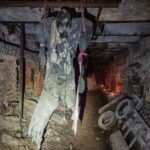
The station nowadays is a gathering place for young people, drinking beer and vodka in the evenings — a nice place with a unique atmosphere. The gallery itself is not guarded by anybody, so you can easily come inside. Several of the escalator rooms are half-flooded, so be ready to wear good shoes. There is a lot of rubbish, which is quite common for most abandoned places in Russia. You can find some traces of homeless people who have been living there, though we haven’t seen any of them.
Current Status
The escalator gallery described in this entry no longer exists in its ruined state. The gallery has been completely rebuilt. The slope was strengthened, and a solid foundation was laid, resistant to local landslides. The architectural design is as close to the original as possible. The new gallery, like the original, connects the Vorobyovy Gory metro station directly to Kosygina Street at the top of the Sparrow Hills via a free escalator, now 68 metres in length. Together with the metro station and its stained glass windows, the gallery is recognised as one of the earliest Moscow monuments of modernism. As of 2026, the escalator operates free of charge, and the passenger throughput of the Vorobyovy Gory station has approximately doubled since the gallery’s reopening. The wider Sparrow Hills area has undergone substantial development: a new cable car connecting Luzhniki to the observation platform opened in 2018, a zipline followed in 2020, and the riverside promenade along the Moskva was fully renovated and reopened in late 2025. The gallery, as a derelict space, no longer exists.

Urbex location:


Hi!
I’ve been there today 🙂
There are containers with people who seemed to maybe guard the place, but I’m not sure so I didn’t get inside even if there are many holes in the fence. I climbed a bit on the side and could take good pictures, there is also a big hole on the fence at the beginning of the stairs on the right side of the station where you can go and see well the inside. Then I didn’t climb till the top in the forest because it was raining and the ground was really slippery.
Anyway thank you for the tips again!
Well, there is no guard, just maybe homeless there. Anyway, thanks for your feedback, we are happy to help!
How and by the way, you could maybe modify a bit the map because the station is what is called “Eskalatornaya Galereya” on the Google Maps a bit more east that the point you used : https://www.google.com/maps/place/Eskalatornaya+galereya/@55.7076331,37.5538097,16z/data=!4m5!3m4!1s0x0:0xed46de4521d1ce58!8m2!3d55.7075615!4d37.5540295?hl=fr
Thank you very much!!! I have updated the map.