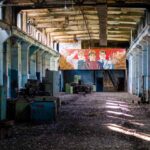

Berlin is known as the city with the most checked-by-controller metro. But at this line you could relax: no tickets, no controllers, not even any trains. Today we will visit the ghost metro line – Siemensbahn.
The city is famous for the density of its transit controllers, the constant low-grade anxiety of riding without a validated ticket. None of that applies here. This branch line runs through northwestern Berlin with no passengers, no conductors, and no trains to check tickets on — only rails disappearing into undergrowth, three stations frozen mid-service, and a steel bridge nobody has crossed safely in decades. The line is reached on foot from the U-Bahn station Siemensdamm: round the corner from the platform, follow the fence line, and a gap eventually opens onto the trackbed itself. From there, the line runs north toward the Spree, through what was once one of Europe’s largest industrial company towns.

Historical Context
A Railway Built by a Factory, for a Factory
The line was constructed between 1927 and 1929 by Siemens & Halske, the electrical engineering firm, specifically to move its own workers between the surrounding residential districts and its sprawling factory complex in Siemensstadt, the company town it had built in Spandau. Siemens financed and built the line itself, including the stations, while the state railway operator, the Deutsche Reichsbahn-Gesellschaft, was responsible only for running trains on it once complete — an arrangement that gave a private industrial concern effective control over a piece of Berlin’s public transit infrastructure. According to company and railway histories of the period, this was possible in part because Carl Friedrich von Siemens, who led the family business, also sat on the Reichsbahn’s administrative board at the time; this detail comes from historical accounts of the arrangement rather than a single verified primary source, and is included here on that basis.
Passenger service began in 1929, initially serving factory shift workers, though ridership quickly broadened beyond them as the surrounding neighbourhood grew. The line survived the Second World War with documented damage to sections of the route; Siemens is reported to have relocated some of its production facilities during the war specifically to reduce the risk of bombing, though certain sites were struck regardless, while the main factory buildings came through comparatively intact. In the war’s aftermath, Soviet forces reportedly replaced a destroyed bridge along the line with a temporary wooden structure and made limited repairs to the track, allowing a reduced service to resume in 1945. Siemens undertook a fuller renovation of the line and its bridge in 1956.

Divided by the Wall, Closed by a Boycott
The construction of the Berlin Wall in 1961 reshaped the line’s fortunes permanently. Running through West Berlin but operated, like the rest of the West Berlin S-Bahn network, by East Germany’s Reichsbahn, the Siemensbahn became one of the least-used branches in the entire system — by 1970 it was down to only a handful of trains per hour. The decisive break came with the 1980 West Berlin S-Bahn boycott, when West Berliners, refusing to fund a rail network they saw as subsidising the East German state, largely abandoned the S-Bahn in favour of buses. Most West Berlin S-Bahn stations were shut down in the aftermath. Siemensbahn was one of them, and because other nearby stations continued operating, the closure caused comparatively little disruption for residents at the time — small consolation for a line that would then sit unused for more than four decades. A 2014 proposal by architecture students in Stuttgart floated the idea of extending the line to connect with the since-closed Tegel Airport; nothing came of it.

Architecture and Space
The Siemensbahn was built as a fully grade-separated, third-rail electrified, double-track branch — modern heavy-rail infrastructure by the standards of the late 1920s, not a tram or light line. Much of its 4.5-kilometre run sits on an elevated steel viaduct and earthwork embankment, carrying the tracks over roads, the factory grounds, and the Spree, with three purpose-built stations along the route: Wernerwerk, Siemensstadt, and Gartenfeld. The stations themselves reflect a restrained, functional industrial-era design rather than any particular ornamental style, built to move large numbers of shift workers efficiently rather than to impress. Decades of disuse have left the steel structure heavily corroded in places and the trackbed reclaimed by vegetation, while the platforms and station buildings vary sharply in condition from one stop to the next.

What We Found
I was expecting to find one abandoned metro station, but instead I found three, together with a beautiful, half-ruined bridge.
Following the rails felt like walking through a jungle. Trees were growing even on the sleepers, and in some places, it was hard to move at all.
Waiting for a Train That Never Comes
I kept walking, following the rails, and then the first station appeared. It was strange because it looked almost completely fine: below was a bus parking area, people going about their business under the bridge, and me standing up on the station, waiting for a train that would never come. Inside one of the buildings, there was even a room where I could have waited for it.
Then I continued. Soon, near the rails, I found a broken bicycle, then an old trolley, a chair — it seemed like homeless people had been living here, sometimes bringing old things in from the nearest trash. Then, on its own, a two-floor building appeared. Half-burned, half-broken, it had nothing special inside.

The Broken Statues
Then came the last station on the way. It was the most interesting one because of some half-broken statues lying on the platform.
The Bridge You Shouldn’t Cross
Then it was the way back, to the final station I had missed and to the bridge. The station was fenced with an iron barrier, but nothing is impossible — I just climbed down past it. Here it was a little more dangerous: there were holes in the floor you could easily fall through, which is presumably why the fence was there in the first place.
The bridge was beautiful. You genuinely cannot cross it — it’s full of holes you could fall through, straight down to the river. The boards were overgrown with moss, and it was obvious that a long time had passed since anyone had last set foot on them.

Current Status
At the time of writing, in 2026, the Siemensbahn’s status as a ruin is coming to an end. Deutsche Bahn has confirmed that full reconstruction work is scheduled to begin on 14 August 2026, with revenue service targeted to resume on 20 December 2029 — deliberately the hundredth anniversary of the line’s original opening. The project, budgeted at roughly €880 million, will rehabilitate the Spandau viaduct, build a new bridge across the Spree, renew around ten kilometres of track, replace or restore some thirty smaller bridges, and bring all three stations up to modern accessibility standards. It is being driven by the redevelopment of the surrounding Siemensstadt Square district — a mixed-use project expected to bring around 20,000 jobs and 7,000 apartments to the area by 2035 — and Deutsche Bahn projects up to 40,000 daily passengers once the line reopens. A construction alliance of nine firms was formally contracted in September 2025, and in April 2026, Deutsche Bahn held a public information evening near the former Siemens-Turm station building, drawing roughly 200 residents to discuss construction schedules and noise protection during the coming works. A separate, unresolved conflict has emerged with the planning authority DEGES over a proposed extension of the A100 motorway, whose support columns near Jungfernheide station would cut into the Siemensbahn’s embankment; Deutsche Bahn has stated it is prepared to challenge the motorway’s planning approval in court. No binding decision has been made on a further extension of the line beyond Gartenfeld to Hakenfelde, a route studied since 2019 whose results remain unpublished as of this year. What has been documented as a decades-long ruin, in other words, is now an active construction site in waiting.


Urbex location: