It was a sunny spring day when two travellers decided to reach Tarfaya in Morocco and the abandoned ship Armas to see how it is today. They were afraid that the ship would already be dragged to scrap, but everything was in its place…like the ship sank yesterday…
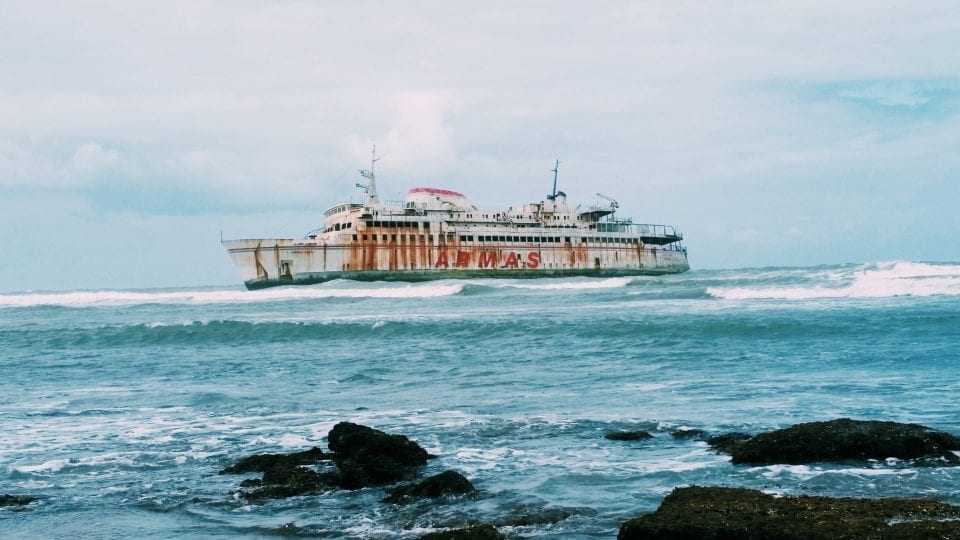
Off the coast of Tarfaya, a small port town in southwestern Morocco, the rusted hull of a car ferry sat half-submerged for sixteen years, close enough to shore to photograph from the beach and far enough offshore that reaching it required intent. Two travellers who made the trip on a sunny spring day, worried the wreck might already have been dragged away for scrap, found it exactly as it had been left — as if it had run aground the day before rather than nearly a decade earlier.

Historical Context
A Town Built Around a Single Airfield, and a Ferry That Barely Lasted
Tarfaya, previously known as Villa Bens during the period of Spanish administration, sits on Morocco’s Atlantic coast near Cape Juby, a small town whose main claim to international recognition has little to do with shipping and everything to do with aviation history: it was here, in the 1920s, that the French airmail carrier Aéropostale built an airfield, and where the writer and pilot Antoine de Saint-Exupéry served as station manager. Maritime traffic came much later and lasted far more briefly. In early 2008, the Spanish shipping company Naviera Armas launched what was then the first regular ferry connection between the Canary Islands and the African mainland, operating a car ferry three times a week between Tarfaya and Puerto del Rosario on Fuerteventura. Locally, the vessel was known simply as the “Armas ship,” after the operating company. However, its registered name was Assalama, and it sailed under a Panama-registered flag, a flag of convenience common in international shipping.
The Morning the Ferry Ran Aground
On the morning of 30 April 2008, the Assalama left Tarfaya bound for Fuerteventura in weather rougher than expected for the season, and shortly after leaving the harbour, it struck a breakwater in heavy seas, opening a leak in the hull. The captain initially attempted to continue the crossing, a decision that was later judged, in the words of local reporting, to have been a mistake once the extent of the damage became clear; within roughly an hour, the ship had begun to lose speed and list heavily, and the crew triggered an evacuation. At that point, the ferry was roughly five kilometres offshore, carrying 113 passengers and crew — for whom there were only two functioning lifeboats. What could have been a maritime disaster instead became a story about local fishermen: at least ten of them put out to sea from Tarfaya in small open boats, none trained in maritime rescue, and between them brought every single person off the sinking ferry alive, women and children first, the men remaining on deck until the fishermen could return for them. Spain’s Supreme Court later reviewed the incident after passengers sued the shipping company, and upheld a lower court’s finding that the captain’s decision to deliberately beach the damaged vessel on a nearby shallow shore, rather than attempt to reach port, had been swift, safe, and guided above all by the priority of saving the passengers.

Decline and Abandonment
Survival did not mean comfort. Passengers waited roughly six hours before being taken to hotels in Laâyoune, and at least one later described the experience bitterly, saying that they had been left lying on the ground, treated like animals, without so much as a cup of coffee. Everyone aboard lost whatever they had brought with them — cars, luggage, clothes, money — none of which could be recovered once the ship went down; a 24-hour security presence was subsequently placed on the coastline specifically to keep looters as well as visitors away from the wreck. The estimated cost of salvaging the ship for repair, at the time, ran to between 15 and 20 million euros, a sum the insurer evidently judged not worth spending, and the ferry line itself never recovered: the maritime connection between the Canaries and this stretch of the Moroccan coast was suspended after the accident and, despite repeated government promises to restart it — most recently, as of the years this site was documented, a target date of March 2017 that came and went like the others — no passenger service was ever reinstated on this route in the years that followed.

What We Found
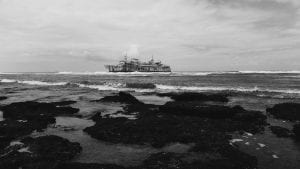
It was a sunny spring day when two travellers decided to reach Tarfaya in Morocco and its abandoned ship, the Assalama, to see how it looked today. They were afraid that the ship would already have been dragged off to scrap, but everything was in its place — like the ship had sunk yesterday.
A Wreck Still Guarded After Nine Years
Since the sinking, maritime communications between the Canaries and the closest point of the African coast were interrupted entirely. There are cargo lines connecting the archipelago with the ports of Casablanca and Agadir, but no passenger passage — which is why people are supposed to arrive here by plane instead. Every time the Moroccan officials promise to reopen the line, they postpone the opening for six more months. And then over and over again, for seven years already. The last time, they promised operations would restart in March of 2017. But even so, until now nothing has changed. Just think how many beautiful things must still be hidden inside.
A Second Cemetery, Closer to Shore
Just near the coastline, from where we were looking at the Assalama, we also saw another “cemetery” of small abandoned boats, sitting quietly in the same stretch of water.

Current Status
At the time of writing, in 2026, the Assalama no longer exists at all. According to Spanish-language reporting from September 2024, the ship was finally dismantled that year following negotiations between Moroccan authorities and Naviera Armas, a demolition process that took roughly four months starting in May 2024, with the wreck’s remains towed away by the Dutch salvage vessel Koole 32 — bringing an end to sixteen years in which the hull sat exactly where it had run aground. Searches for confirmation of whether the Tarfaya–Puerto del Rosario ferry line was ever reinstated found no evidence that passenger service has resumed as of this writing; the route appears to remain suspended, more than a decade past the string of postponed reopening dates recorded here. What this site once offered to photograph — a ship frozen mid-sinking off a Moroccan beach — is now, by all available accounts, simply gone.

Urbex location: