
Upon our arrival in Bangkok, we felt akin to two fish plucked from the water. The transition from Siberia brought about a profound change – warmth enveloped us, vibrant scents filled the air, colours dazzled our senses, and a symphony of noises surrounded us.
Soon after arriving in the capital of Thailand, Bangkok, we went to explore an abandoned shopping mall, made famous by photos of thousands of goldfish swimming peacefully inside the flooded basement.
Historical Context
The New World Shopping Centre was built in 1982 in the Phra Nakhon district of central Bangkok, a few hundred metres from the Grand Palace — the royal ceremonial complex that has served as the official residence of the Chakri dynasty since 1782. The building rose to eleven storeys, which immediately created conflict. Thai residents and municipal authorities considered the scale of a commercial tower in this location an intrusion — visually and symbolically — into one of the most historically sensitive precincts in the country. Under sustained pressure, the upper floors were demolished, and the structure was reduced to four storeys, permanently compromising its commercial viability.
The mall operated for roughly fifteen years before ceasing activity. In 1999, a serious fire broke out inside the building, destroying the roof and leaving the concrete frame exposed to Bangkok’s monsoon seasons. Without a watertight covering, rainwater began accumulating in the lower levels and the basement. The building passed into a state of legal and physical limbo — ownership records in public sources remain unclear — and no coherent redevelopment plan followed.

The Accidental Aquarium
The standing water in the basement rapidly became a breeding ground for mosquitoes, generating complaints from residents in the surrounding streets. The solution that emerged was entirely informal: local people began releasing fish into the flooded interior. Among the species introduced were koi carp, goldfish and several varieties of tilapia. The fish consumed mosquito larvae and, finding conditions adequate, began to reproduce. According to local accounts widely reported at the time, the population eventually reached an estimated 100,000 individuals — a functioning aquatic ecosystem inside an abandoned commercial building in the middle of a capital city.
The site came to international attention largely through the work of photographer Jesse Rockwell, whose images of the flooded interior circulated online and transformed a local curiosity into a globally recognised urbex landmark. Tourists began arriving regularly to feed the fish. The phenomenon lasted until municipal authorities intervened, removing the entire fish population and relocating them to other ponds. The accidental ecosystem was dismantled as deliberately as it had been created.

What We Found
Upon our arrival in Bangkok, we felt akin to two fish plucked from the water. The transition from Siberia brought about a profound change — warmth enveloped us, vibrant scents filled the air, colours dazzled our senses, and a symphony of noises surrounded us. Soon after arriving in the capital of Thailand, we went to explore the abandoned mall, made famous by photos of thousands of goldfish swimming peacefully inside the flooded basement.
Finding the Entrance
The shopping centre is not easy to identify from the outside — you really need to know where it is. Around it, there are hundreds of small merchants, hostels and shops, as if there is no abandoned building behind. First, you have to find the junction of Phra Sumen Road and Chakrabongse Road, where two huge iron plates mark the point where city authorities closed the building. You have to enter from the back, reaching Kraisi Road, where a large car park sits behind the structure. To get inside, you can climb a tree.

Inside the Mall
We came here shortly before sunset, having read online that the most beautiful pictures are obtained at that time. Nothing like that. We quickly climbed the tree and descended into the dark depths of the shopping centre.
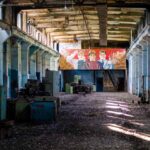
The first floor is almost completely flooded and impossible to reach on foot. But behind the partition that separates the abandoned building from the rest of the world, people live. They have a kitchen, beds, and it seems they use the flooded section of the mall as a waste disposal area. Inside, some excavators stand motionless, evidence that at some point work was started and then simply stopped.


The Bats and the View
You might think you are alone, but you are not. Hundreds of bats occupy the upper interior, making themselves heard whenever a flashlight beam cuts through the darkness or a voice carries too loudly. A remarkable view of the city opens from the upper floors — you look down on one of the world’s largest megacities and watch how everyone is rushing somewhere. While in this place, time stopped.


Current Status
As of 2026, the New World Mall remains standing in the Phra Nakhon district, its street-facing facades sealed with metal plates. The fish population that made the site internationally known has been gone for years, removed in a municipal operation whose exact date varies across sources. Searches of Bangkok Metropolitan Administration records, Thai-language press and recent satellite imagery confirm the building is still present in the urban fabric near the Chao Phraya riverbank and the Grand Palace precinct, with surrounding streets commercially active. No formal heritage listing or certified redevelopment programme for the site appears in national registries as of 2026. The concrete shell stands, the fish are gone, and the basement remains flooded.


Urbex location: