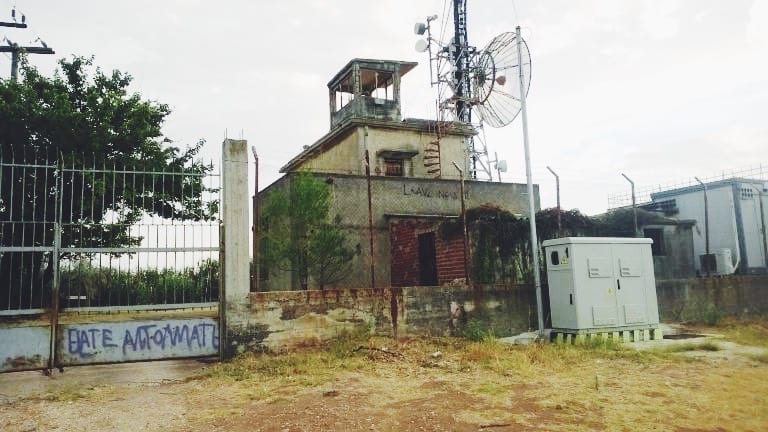
On the edge of the cliff, left alone by time, an old transmitter was resting, ready for the next “speaking”.
It stands where the coastal road gives out, past the pebbled shoreline of Kokkina Vrachia — the “Red Rocks” — on a promontory just outside Alexandroupoli, capital of the Evros regional unit in northeastern Greece. There is no fence worth mentioning, no signage, nothing to mark it as anything other than what it appears to be from the road: an old technical building near the university, its antenna still upright against the sky. For decades, this structure was part of the nervous system of Greek telecommunications, one of the relay points that carried voice and signal across a country whose terrain — mountains, straits, scattered islands — has always made direct transmission difficult. Today it belongs to no one in particular. The gate is open. The building waits.

Historical Context
From a Fishing Village to a National Network
Alexandroupoli itself is a young city by Greek standards, built up from a mid-nineteenth-century Ottoman fishing settlement originally known as Dedeağaç, and renamed in 1920 in honour of a royal visit. Its growth tracked the arrival of the railway and the port, and by the twentieth century it had become the administrative capital of Thrace’s easternmost province — a border region facing Turkey across the Evros river, and historically one of the more isolated corners of the national grid.
That isolation is the context in which a station like this one existed. OTE, the Hellenic Telecommunications Organisation, was founded on 23 October 1949 as the postwar successor to a patchwork of private and semi-private operators — chief among them AETE, the urban telephony company in which Siemens und Halske held the controlling stake, and Cable & Wireless, which had handled international telegraph and telephone traffic. The country’s telephone infrastructure had been largely destroyed during the occupation and civil conflict of the 1940s, and OTE’s founding mandate was reconstruction on a national scale. Over the following decade, the number of automatic telephone connections in Attica alone rose from roughly 43,000 to more than 100,000, and international lines expanded from fifteen countries to nearly all of Europe and much of the wider world.
Reaching the periphery — provinces like Evros, hard against the border and far from Athens — required more than cable. For much of the twentieth century, Greece’s domestic network depended heavily on microwave radio relay to move calls across difficult terrain, chains of line-of-sight stations passing signal from hilltop to hilltop and coastline to coastline. A promontory above the sea, with a clear view toward Samothraki and the open Thracian Sea, is exactly the kind of position such a network needed. Site information places this particular installation in service from 1990, functioning as a relay point for OTE’s regional transmission traffic; that starting date could not be independently verified beyond the record kept on site, and is retained here on that basis.

Decline and Abandonment
The technology this building served did not fail so much as it was superseded. From the 1990s onward, OTE progressively rebuilt its backbone around fibre optics and, later, digital and satellite links, a modernisation that accelerated through the company’s 1996 privatisation and its subsequent restructuring under Deutsche Telekom. Analogue microwave relay stations across the country, once essential, became redundant one by one as traffic moved onto denser, faster infrastructure. No public record of a formal decommissioning date for this specific station was found; what remains is consistent with a facility simply switched off and left as capital assets elsewhere in the network were prioritised — a pattern repeated at similar sites nationally rather than a decision particular to this location.


What We Found
Just an open gate blocks the way in — no guards, no curious passersby, cut off from the rest of the tourist traffic like an invisible bubble. That kind of quiet, unofficial protection is often what keeps a place like this both abandoned and unnoticed.
Past the gate, there was an open iron door. It seemed like the easy way in, so I took it. My friend George stayed outside with the bikes, keeping watch.
Three Floors of Paper
The building had three levels: the ground floor, the first floor, and what I counted as a third floor simply because of the stairs leading up to it — more of a roof access than a real storey. On the ground floor, there were three rooms. All three were full of papers, archives, and boxes. To the right, telecommunications equipment, some broken, some not. To the left, a dark room where the floor was covered in paper instead of concrete. There was also a small, hidden bathroom.
Climbing the stairs, moving quickly because time was short, I reached the first floor. A metal door, half torn from its hinges, opened onto what was probably once the central control room — the place from which signals were sent out across the whole area. More shelves, more documents, worn down by weather and time. Through another open door was a kind of terrace, and from there an old spiral metal staircase led further up.


The View From the Roof
I called out to George while I was climbing, feeling the stairs sway under me from side to side, like being on a seesaw. From the top, the view was extraordinary: the sea, the sunset, Samothraki in the distance, the red rocks below — only George’s arrival broke the spell. The antenna stood right there next to us, unmoved by all of it, exactly as it must have stood for decades.
Current Status
As of 2026, searches for recent municipal, heritage or OTE corporate records specific to this installation returned no results — no listing in heritage protection databases, no announced redevelopment or demolition plans, no local news coverage of the site by name. What can be said with more confidence is the general pattern into which it fits: OTE’s continuing shift toward fibre-to-the-home and digital infrastructure, part of a modernisation plan extending through the end of this decade, has made small legacy relay stations like this one low priorities for either preservation or removal. Barring any changes since these photographs were taken roughly two years before publication, the building most likely remains standing, unsecured, and unrecorded — one of an unknown number of similar structures scattered along the Greek coastline.

Urbex location:


